 It’s always an interesting proposition when an author jumps to another genre. Will the elements of their successes in one venue parlay into equal success in another? Will the story be as entertaining as the previous works, despite a complete change of storytelling scenery, with different tropes and expectations? Readers of this blog are well aware that I’m decidedly more comfortable with fantasy novels, only branching into science fiction rarely. So when I heard that Michael J. Sullivan was using Kickstarter to produce a science fiction story, I was curious to see if my love for Sullivan’s work would extend to a story outside of the Riyria series. I’m happy to report that not only does Hollow World establish Sullivan as a force to be reckoned with in any genre he chooses to ply his talent to, it also is a prime example of one of the reasons speculative fiction is so important. Hollow World is an excellent and thought provoking novel that tackles big issues yet does so in such a way to allow the reader to draw their own conclusions once they reach the end of this thoughtful, entertaining and compelling science fiction murder mystery.
Showing posts with label Michael J. Sullivan. Show all posts
Showing posts with label Michael J. Sullivan. Show all posts
Monday, November 11, 2013
Hollow World by Michael J. Sullivan
It’s always an interesting proposition when an author jumps to another genre. Will the elements of their successes in one venue parlay into equal success in another? Will the story be as entertaining as the previous works, despite a complete change of storytelling scenery, with different tropes and expectations? Readers of this blog are well aware that I’m decidedly more comfortable with fantasy novels, only branching into science fiction rarely. So when I heard that Michael J. Sullivan was using Kickstarter to produce a science fiction story, I was curious to see if my love for Sullivan’s work would extend to a story outside of the Riyria series. I’m happy to report that not only does Hollow World establish Sullivan as a force to be reckoned with in any genre he chooses to ply his talent to, it also is a prime example of one of the reasons speculative fiction is so important. Hollow World is an excellent and thought provoking novel that tackles big issues yet does so in such a way to allow the reader to draw their own conclusions once they reach the end of this thoughtful, entertaining and compelling science fiction murder mystery.
Wednesday, September 11, 2013
The Rose and the Thorn by Michael J. Sullivan

Prequel stories are a dangerous proposition; just ask George Lucas. The knowledge of what comes after, of the end game if you will, can taint the enjoyment of these stories from the very beginning. The stakes are even more daunting when the principle property is beloved by a legion of fans. Even after reading Michael J. Sullivan’s excellent first prequel novel to his uber-successful Riyria Revelations series, The Crown Tower, and loving it, I was a bit concerned that he might not be able to catch lightning in a bottle again.
While not as satisfying as the previous effort, The Rose and the Thorn is still packed with all of the things that made Sullivan such a powerhouse in the genre. There are banter and battle in equal measure, a touch of romance, sharply drawn characters, and the wonderful blend of nostalgic sword and sorcery that hearkens back to the books that led many thirty and forty-something readers to the genre in the first place.
Monday, July 29, 2013
The Crown Tower by Michael J. Sullivan
I'm confident that having a popular and well received series is the dream for most authors. Unfortunately, many authors of such series develop what I like to call "cash cow" disease, and their series drag on coming more and more bloated as the author milks every last drop of financial success from the property, diluting what was once a intriguing property by forgetting that sometimes less is more. When I heard that Michael J. Sullivan was releasing prequel novels to his excellent and completed Riyria Revelations, I worried that any return to the lives of Hadrian and Royce would pale in comparison to the completed series. Sullivan closed the door on these characters well and left almost no unanswered questions on the table, leaving my concerned that these prequel novels would be irrelevant to the series as a whole. I couldn't have been more wrong. The Crown Tower is a worthy addition to the Riyria property, full of the excellent characterization and light-hearted sense of adventure that made Sullivan such a success. More importantly it deepens the readers understanding of the protagonists and adds a richness to the preceeding books thus rewarding readers that have already devoured the preceding six volumes.

The books back copy follows:
Sullivan also structures the story so that it can be read either as the beginning of the series or in the order of publication. There are benefits to both approaches, as Sullivan seeds the narrative with nods to the events of his previous novels. These tips of the hat, give the long time reader a sense of being in on the process, and they rarely feel forced. Newer readers who approach the series through the prequel novels first ,will benefit of seeing the pay off, with Sullivan's careful attention to not spoil the tension and big reveals of the later books with his nods to his legions of fans.
Sullivan also introduces Gwen DeLancey as a point of view characters for the first time in The Crown Tower. With the majority of the female protagonists not appearing until much later in the series' timelines, it makes perfect sense that Gwen would be used in such a way. This choice also adds depth to a well loved supporting character and makes Gwen's later relationship to one of our heroes make much better sense. These sections were some of my favorites, not just because of the newness of them but due to expert way that Sullivan portrays Gwen. Though she starts the novel as a prostitute in a hole of a brothel, she never lacks agency and Sullivan handles the more adult themes of her circumstances with a touch that is light, but yet not so squeaky clean as to become unrealistic. Gwen is just as much the hero of her story as Royce and Hadrian and the fact that she stays far removed from their exploits only strengthens her as a compelling protagonist. I certainly am looking forward to more of her story in the rapidly approaching The Rose and the Thorn.
The Crown Tower is Sullivan doing what he does best. As I've said in other reviews of Sullivan's work, if you are looking for a return to the fantasy of your youth that manages to still feel relevant without burying itself in the grit and blood of Abercrombie, Martin, or Morgan, then you should look no further. Snappy banter, desperate stakes, pulse pounding sword play, and good old fashioned heroics are all on full display here. Everything you've come to expect from the adventures of Hadrian and Royce is contained within the pages and with the addition of Gwen's chapters there is a richness that I certainly wouldn't have expected in what so easily could have been a "cash cow" add on to a beloved series. I hope that there are many more novels to fill in the twelve year gap between The Crown Tower and Theft of Swords, especially if they are half as good as this one.

The books back copy follows:
TWO MEN WHO HATE EACH OTHER.Sullivan begins The Crown Tower before his protagonists have met and allows the reader to spend quite a bit of time with Hadrian before he begins his association with Royce. This was a inspired choice, giving readers time to soak up the difference between this younger, and surprisingly even more idealistic version of the character they have grown to love. This becomes very important as the easy familiarity and friendship between the warrior and assassin are nowhere to be found in this volume. Sullivan doesn't take the easy route to establish the character's partnership. This is far less about their first adventure than it is about the process of forging the bond between them. The sparks fly and there is plenty of bickering replacing the banter of the Riyria Revelations. In a lot of ways the snark is even more entertaining when there is real vehemence behind it, but the sense of humor that underlies it all hints at the partnership that readers know is coming. Sullivan does an excellent job of showing why these two loners need each other and how the pairing of their skills and world views will strengthen and eventually redeem them both.
ONE IMPOSSIBLE MISSION.
A LEGEND IN THE MAKING.
A warrior with nothing to fight for is paired with a thieving assassin with nothing to lose. Together they must steal a treasure that no one can reach. The Crown Tower is the impregnable remains of the grandest fortress ever built and home to the realm’s most valuable possessions. But it isn’t gold or jewels the old wizard is after, and this prize can only be obtained by the combined talents of two remarkable men. Now if Arcadias can just keep Hadrian and Royce from killing each other, they just might succeed.
Sullivan also structures the story so that it can be read either as the beginning of the series or in the order of publication. There are benefits to both approaches, as Sullivan seeds the narrative with nods to the events of his previous novels. These tips of the hat, give the long time reader a sense of being in on the process, and they rarely feel forced. Newer readers who approach the series through the prequel novels first ,will benefit of seeing the pay off, with Sullivan's careful attention to not spoil the tension and big reveals of the later books with his nods to his legions of fans.
Sullivan also introduces Gwen DeLancey as a point of view characters for the first time in The Crown Tower. With the majority of the female protagonists not appearing until much later in the series' timelines, it makes perfect sense that Gwen would be used in such a way. This choice also adds depth to a well loved supporting character and makes Gwen's later relationship to one of our heroes make much better sense. These sections were some of my favorites, not just because of the newness of them but due to expert way that Sullivan portrays Gwen. Though she starts the novel as a prostitute in a hole of a brothel, she never lacks agency and Sullivan handles the more adult themes of her circumstances with a touch that is light, but yet not so squeaky clean as to become unrealistic. Gwen is just as much the hero of her story as Royce and Hadrian and the fact that she stays far removed from their exploits only strengthens her as a compelling protagonist. I certainly am looking forward to more of her story in the rapidly approaching The Rose and the Thorn.
The Crown Tower is Sullivan doing what he does best. As I've said in other reviews of Sullivan's work, if you are looking for a return to the fantasy of your youth that manages to still feel relevant without burying itself in the grit and blood of Abercrombie, Martin, or Morgan, then you should look no further. Snappy banter, desperate stakes, pulse pounding sword play, and good old fashioned heroics are all on full display here. Everything you've come to expect from the adventures of Hadrian and Royce is contained within the pages and with the addition of Gwen's chapters there is a richness that I certainly wouldn't have expected in what so easily could have been a "cash cow" add on to a beloved series. I hope that there are many more novels to fill in the twelve year gap between The Crown Tower and Theft of Swords, especially if they are half as good as this one.
Saturday, April 6, 2013
Coming Attractions: The Rose and the Thorn by Michael J. Sullivan
Fresh on the heels of the end of his Hollow World Kickstarter, Michael J. Sullivan has even more to crow about. Orbit has released the cover art and synopsis for the second of his Riyria prequel novels, The Rose and the Thorn. With the release of the first volume, The Crown Tower just around the bend, I'm excited to learn that the entire dualogy will be mine before years end. Fans of Royce and Hadrian are in for a good year, and Sullivan is yet again an author to watch.

Two thieves want answers. Riyria is born.
For more than a year Royce Melborn has tried to forget Gwen DeLancy, the woman who saved him and his partner Hadrian Blackwater from certain death. Unable to get her out of his mind, the two thieves return to Medford but receive a very different reception --- Gwen refuses to see them. The victim of abuse by a powerful noble, she suspects that Royce will ignore any danger in his desire for revenge. By turning the thieves away, Gwen hopes to once more protect them. What she doesn't realize is what the two are capable of --- but she's about to find out.
So tell us, are you more excited by Sullivan's return to his fan-favorite stomping grounds, or his journey into new territory with Hollow World?
Sunday, January 13, 2013
Spec. Fic. Writer's 101: Plotting with Michael J. Sullivan
I know I've been conspicuously absent from the blogsphere and I want to take a moment to sincerely apologize to everyone who has been reading and commenting on my ruminations since I started this little vanity project. Real life and my own tendency to over-extend myself got the best of me for a while but I'm back and here to stay, though I doubt I'll be as prolific as I once was. With that said, I am happy to continue the Spec. Fic Writer's series with this entry on plotting by Michael J. Sullivan. Michael's a real genre success story one of the first to go from self publishing into the wider acclaim enjoyed by those who follow the more traditional road. He's a gentleman and scholar and has been a joy to read, interview, and work with on this subject. I trust you'll find his advice as enlightening as I did. Enjoy.

In various online forums I’m usually surprised when someone new to writing asks for advice as to whether to outline their plots or is it better to be a “pantser” (develop the story as you go – named for flying by the seat of our pants). The notion that anyone would ask such a thing, as if they could will themselves into one or the other based on popular opinion, shows that people are struggling to develop techniques to help them find their way. But there is no right answer to this question, and each author needs to find what works for them. For some, outlining will destroy their creativity. They prefer to discover as their characters do. The downside is you can write yourself into a corner, which could result in abandoning the book or at least having to do significant rewriting.
In various online forums I’m usually surprised when someone new to writing asks for advice as to whether to outline their plots or is it better to be a “pantser” (develop the story as you go – named for flying by the seat of our pants). The notion that anyone would ask such a thing, as if they could will themselves into one or the other based on popular opinion, shows that people are struggling to develop techniques to help them find their way. But there is no right answer to this question, and each author needs to find what works for them. For some, outlining will destroy their creativity. They prefer to discover as their characters do. The downside is you can write yourself into a corner, which could result in abandoning the book or at least having to do significant rewriting.
I’ll share my technique, as it might be helpful to those haven’t yet found what works for them…do both. I always start a book with a “light outline” this may mean just a few sentences per chapter, or a listing of a number of scenes that I’ve already thought about before beginning. I don’t start writing until I know where I’m heading, but, and here is the important point, that doesn’t mean you can’t change direction as the story begins to unfold. I look at the process much like a road trip.
If I’m traveling across country I’ll start with a given route and make plans where to stop to get a bite to eat or to spend the night. Along the way I’m not so focused on the trip that I ignore something interesting that I may happen upon. I’ll take that unplanned exit, and explore that back road. Perhaps I’ll be rewarded by a really cool covered bridge or a breathtaking view. It may even give me an idea at a different destination…and that’s fine.
Characters and plots grow naturally out of plausibility and creative bursts that redirect the story. Fighting these opportunities can result in a stiff, contrived book. The trick I found was to take those unexpected paths, but then reorient the outline to accommodate for it. The idea is to always be able to see the end from where you are in the story. If at any point you make a turn and you can’t see exactly how your story ends, then you have to stop, take an hour or so and work out the problem before starting again. Once solved, you resume until the next unexpected turn. The worst thing you can do, is push on blindly writing tens of thousands of words and find yourself in a locked room that your character can’t possible escape from.
So my outlines are pretty fluid things, and little more than skeletons with some chapters having only the single bullet point "something happens here." Here is an example of how I might have outlined the start of The Wizard of Oz.
The Farm (Depression era Mid-west)
- Gulch arrives with court order to take Dorothy’s dog Toto
- Dog escapes returns to Dorothy
- Dorothy fearing for Toto’s safety runs away from home
On The Road
- Dorothy runs into circus performer/seer/wizard
- Old guy scares Dorothy into going home
You can see a lot of potential problems already. There are a lot of unexplained questions. Why is Gulch upset with Toto? How does Toto escape? Who exactly is the old guy and how does he scare Dorothy into going home? And these are just plot issues. What about setting and characterization? Where does this story take place? Nebraska, Kansas, Oklahoma? Who is Dorothy living with—parents? What are they like? Does she have brothers and sisters? Farm hands? Neighbors?
These kinds of questions can often be explored while writing. In doing so, you can still have the fun and excitement of discovering things about the story and yet, feel secure that the story will work out in the end.
Building an outline is pretty simple. You just start with a few ideas: where the story starts; something that happens in the middle; and then the end. This gives you three bullet points. You run the story though your head a few times and you get more ideas—more points. If you’re lucky you know the anti-climax and the climax. Imagine telling your idea to someone. What questions might they ask? (Exactly how old is this Dorothy? How are you going to account for Oz?) Answering these questions add more points to the outline. After a while these bullet points work like one of those draw-by-number pages. You can sort of see the story taking shape. Still it isn’t until you begin writing, that you draw that line that connects the dots and the whole thing comes alive. A few dots might need to be moved, some erased and some added, but in the end you have a well constructed story ready for polishing.
I hope this is helpful to those trying to find their own approach. Remember, there is no single right answer (and probably why it’s asked so often). Bottom line, the more writing you do, the closer you’ll come to developing your own system that gives you the right balance of the “fun of discoverability” and the “satisfaction of completing” a novel that follows a given story arc.
Tuesday, October 23, 2012
An Interview with Michael J Sullivan
Fresh off the announcement of his upcoming Riyria Chronicles and my review of the preceding Riyria Revelations, I contacted Michael J. Sullivan about doing an interview. After choosing to answer questions one by one in a conversational format much like I used in my interview with Stina Leicht, we got down to business. The following interview took some time to finish, largely due to some health issues in my family, but I am very pleased with the final product. Michael was a pleasure to work with, and his answers leave no doubt as to why he has been so successful.

52
Reviews:
As an author's whose biggest success story seems to be your rise from
writing stories that you had no intention of publishing, to
self-publishing phenomenon, and finally as a well recognized author
with books in every major bookseller across the country, which step
in the process was the most rewarding and why?
Michael
J. Sullivan:
Good question. I think it is probably the knowledge that my early
writing years weren’t a complete waste of time. I’m not sure how
many people know this, but I wrote twelve novels over the course of a
decade. While I knew most of those books were simply throwaways (work
done to teach myself how to write), I thought the last three of four
were of publishable quality. After years of rejection, I started
feeling like Linus from the Peanuts waiting for the Great Pumpkin. I
had seen my friends develop respected careers while I accomplished
absolutely nothing. This caused me to quit writing altogether.
As
you already mentioned, I started again (a decade later) but only on
the condition that I wouldn’t publish. I had already concluded that
way led to frustration, pain, and despair. If my wife hadn’t
insisted on getting my Riyria Revelations “out there,” I would
have died regretting not making better use of that time. Because I
finally “made it,” all those hours magically transformed from a
complete waste to necessary prerequisites…my contribution to
Gladwell’s 10,000 hours if you will.
52
Reviews:
Do you think that writing with the condition to not seek publication
allowed you a freedom to write without expectation? If so, do you
think that contributed to the success of the resulting work?
Michael
J. Sullivan:
In
some respects, every first-time writer has freedom from expectation.
It’s only once you’re known for something that that comes into
play. For me, the main byproduct of writing without publication as a
goal was that I had an extremely narrow audience to please…myself.
Given how dark and gritty fantasy had become over the years, if I had
wanted to seek publication, I would have followed that trend.
Instead, I wrote what I wanted to read: a fast-paced adventure with a
couple of guys I wanted to hang out with.
As
to success, well I think the jury is still out on that. Don’t get
me wrong, I’m really pleased with how the books have been received
so far, but I think there is still a very long road ahead. Whether it
runs out of steam and fades into obscurity, or gains momentum and
finds a place in the fantasy landscape, is just too foggy a future to
predict. When readers mention my books along with the likes of
Sanderson or Rothfuss, I find it a bit surreal. In many ways I feel
like a freshman at a new high school, watching the “cool kids”
chatting at the “big boys” table. Sure I’d like to be invited
to sit down, but it’s still way too soon to even consider such a
notion.
52
Reviews:
Speaking of the trend of darker, grittier stories in modern fantasy,
do you believe that the last decade with it's nearly continuous wars,
financial insecurity, and political back biting has contributed to
this trend? And if so, do you think that part of the success of the
Riyia Revelations is due to its focus on characters who for all their
flaws are obviously noble and heroic and the generally more hopeful
tone of the storyline?
Michael
J. Sullivan:
I’m not sure the “social climate” was a factor, but I don’t
study such things, and could be dead wrong. I think it has more to do
with a constantly swinging pendulum. There was a time when fantasy
was too idealistic with shiny heroes and happily-ever-afters. I think
a few authors started bucking the trend, and it breathed new life
into the genre. Publishing, being what it is, saw that this “new
style” was selling, so a lot of acquisitions editors started
looking for more of that. Given the pervasiveness of the
dark-and-gritty I wouldn’t be surprised to see the pendulum swing
back again.
Your
assessment on my own characters is pretty accurate in that they are
flawed, complicated, and have their own demons to run from, but they
are aspiring to do the right thing and will rise to the occasion. To
be honest I wasn’t trying to “buck a trend.” I was just writing
the type of fantasy I enjoy to read. I do prefer my reading to be
escapist, especially given the social conditions you mentioned, and I
want to feel better after reading then when I start. One of the
criteria that draws me to a work is characters that I enjoy and would
like to know in real life. I do hear A LOT of comments from people
saying things like, “This is the type of story that reminds me why
I fell in love with fantasy in the first place.” And I must say
that I get a certain amount of pleasure out of that. But I wasn’t
trying to “time the market in any way.” In fact, at the time I
started thinking/writing the series it was before the transition
occurred…so I guess for me it was good that it took so long to
reach the market. A case of “what’s old” is new again.
52
Reviews:
You mentioned readers commenting on the similarity between Riyria and
the stories that led them to a life long love of the genre in the
first place. What books and authors served as gateways into the genre
for you personally? Are there other authors in the market today who
are also writing more 'escapist' fantasy that you would recommend to
your readers?
Michael
J. Sullivan:
While it’s not very original, and I feel like I should make up some
inventive story so I seem more interesting, but it was The
Hobbit and
The
Lord of the Rings That
got me started. My brother was reading them and would wake me up in
the middle of the night to tell me what had happened.
A
few years later, I found the books and then devoured them for myself.
Prior to that I had read only a single book (and hated that one).
Directly after reading Tolkien, I started writing my first story,
because I wanted to make up my own world and characters. At the time
there really wasn’t a lot of other fantasy for me to choose from
especially after I finished C.S. Lewis’s Narnia Chronicles and
Le Guin’s Earthsea Trilogy. They say necessity is the mother
of invention, and for me boredom is the mother of creativity. When I
didn’t find much else to read that’s when I really started
devoting time to writing so I could get “exactly” what I liked.
Eventually Eddings and Feist came along and I had something to read
again.
As
to “modern writers” the two I’ve enjoyed the most in recent
memory are Sanderson’s Mistborn, and Rothfuss’s Name of
the Wind. I keep trying the names that I hear often (Martin,
Weeks, Lynch, Abercrombie, Cook) and while I can appreciate their
storytelling ability and the craft of their writing, I don’t
particularly want to escape to their worlds or pal around with their
characters. For the most part it has been some of the young adult
stuff that I’ve had to turn to for that: Rowling’s Harry
Potter, Stroud’s Bartimaeus Trilogy, and even works for
young readers such as Jacques’ Redwall.
52
Reviews:
In talking about Riyria with friends, I've found the same responses
come up over and over again about the series. Royce and Hadrian seem
to be the driving force of the series popularity. I personally find
the back and forth between the pair to be the heart of the series,
bringing to mind the best buddy-cop movies only in a different
setting. Did Royce and Hadrian come to you as a pair, or was one the
starting point with the other created as a foil?
Michael
J. Sullivan:
They’ve always been a pair, and doing so has allowed me to explore
multiple aspects through their differences. From time to time someone
mentions one of them as a “sidekick” of the other, which I find
it interesting because to me they have always been equal partners. A
lot of people think I drew inspiration from Lieber’s Fafhrd
and Gray Mouser,
but I’ve never read any of those books, and in fact didn’t even
know they existed until after my series was completed. I think the
real inspirations come from two sources, one conscious and the other
subliminal. The conscious one was Butch
Cassidy and the Sundance Kid one
of the first movies I saw and really enjoyed (yes this dates me). The
second dates me even further, and it’s a television series called I
Spy,
starring Bill Cosby and Robert Culp. It was only recently that I
happened upon them again while channel surfing and said to myself,
“Hey, they’re a lot like Royce and Hadrian.” I’m sure the
years of exposure to them had an impression. Oh, and there was also
Sam Becket and Al Calavicci from Quantum
Leap,
still old but at least some of your readers might know who they are.
52
Reviews:
Since you had the luxury of having most of the series completed
before publication, I find it hard to decipher whether you are a
discovery writer or if you plotted the entire series before you
started. Which camp do you fall in, and what can you tell us about
your writing process for a series with so many volumes?
Michael
J. Sullivan:
Actually, I’m a little of both. I pretty much thought of The
Riyria Revelations as
one long tale, divided into separate episodes, and had an outline for
both each book as sell as one for the entire series. But these would
change as the writing process went along. A lot of times it’s like
navigating a ship at sea. I know where I started and where I’ll end
up, but at each compass check I might adjust course. If I find
something particularly interesting, it may change the destination
completely, but I never adjust the sails until I know that the new
course is definitely the way I want to go.
Many
times when I get done with each book, I’ll let it “simmer” for
a few weeks and I’ll constantly challenge myself to see if there
are ways I can ramp it up a few notches. Usually there will be
something really juicy that was lurking at my subconscious level that
will bubble to the top, and a few minor adjustments will really make
a big difference. For instance, in The Emerald Storm I took
great care to show the meticulous planning capabilities of Merrick
Marius but I was able to take that to a whole new level by going back
and tweaking a few things to really punctuate that point. It provided
a “surprise ending” that surprised even me because it wasn’t
planned consciously from day one. It must have been there all along,
because it only took a bit of adjustment to make all the pieces fit.
The
ending of the series is interesting because at various stages I would
trade one good ending for a better one. As I was
finishing the fifth book I had two or three ways I could conclude the
series, all of which were very satisfying, but I knew I had not quite
found “it.” I was missing something. It’s like looking at a
puzzle and seeing there is something recognizable but not being able
to put my finger on it. One day, during a torrential rainstorm while
I was picking my daughter up from work, the pieces finally slipped
into place…and the ending was…dare I say, perfect. This required
me to go back and adjust threads earlier in the books. I even had to
add a character or two, but I “knew” this was the ending I had
been setting up all along.
52
Reviews:
Many of your secondary characters grow into much more important roles
in the story becoming almost as important as Royce and Hadrian. Was
there ever a time where one of your characters stood up and told you
where they wanted to go?
Michael
J. Sullivan:
Oh that happens all the time, and I’ve learned that it is best to
listen to them when they defy my original intentions. There are also
characters that get more “screen time” because they turn out to
be so entertaining. I know that many people see these books as Royce
and Hadrian’s tales, and there are good reasons for this, but for
me I’ve always considered this series to have four main characters:
Royce, Hadrian, Arista, and Thrace/Modina. By the end of the series
it becomes apparent that the women stand toe-to-toe with the men, but
early on Arista and Modina are given secondary status by design as I
wanted to show their growth. Much of what makes Royce and Hadrian who
they are occurs in the past, and we see the results in their
“current” bonds of friendship. But Arista and Modina are put to
the anvil through events as they occur. We get to see me pound their
metal into stronger stuff. Their stories really start to come into
the spotlight with the third book, Nyphron
Rising.
Those who stop after the first pair will never get exposed to the
full effect, but it’s a technique where the payoff is worth the
risk.
The
best example of my characters refusing to submit to my will came in
the sixth book. A party rides out from Aquesta (the capital of the
current empire) on their way to Percepliquis (the ruins of the
original empire). Along the way they wanted to stop and spend the
night in Ratibor (a nearby town that was the setting for much of the
third book). I REALLY didn’t want to go there. It’s a place that
I’ve already visited, and I was anxious to get to the party to the
“really good stuff,” which was entering Percepliquis. But it was
cold, and snowy, and they insisted in staying at an inn. So I let
them go. This resulted is some of my favorite scenes in the book. As
I was writing I realized that there were all kinds of opportunities
that could be fulfilled by that one night stay in Ratibor, and I’m
grateful that they refused to follow my initial directions.
52
Reviews:
One of the things I like best about the Riyria Revelations is the way
you slowly details about the setting often only showing a single
larger piece per novel. This allows for a more subtle way of
inserting exposition and detail. I've read that you prefer to write
with a light touch, trying to remain nearly invisible to your readers
so as not to distract them from the story. Was the slow reveal of the
setting, part of that effort? What else can you tell us about
"writing lightly"?
Michael
J. Sullivan:
I actually see two things here. The first is slow
reveals,
which is a pretty non-conventional approach, particularly in
traditional publishing. Because I wasn’t planning on releasing any
of the books, I didn’t concern myself with “front loading”
character background and world building. I wanted to reveal this
information slowly over the course of the entire series. When
traditionally published, a book has to make it through the gauntlet
of agents and acquisition editors, and to do that it must be packed
with all the choice
cuts.
I think this is why some series start out strong and end weak,
because all the “good stuff” was in the first book. My Riyria
Revelations is
just the opposite. Because my readership was myself, my immediate
family, and a few friends, I knew my audience would read it in its
entirety, so I concentrated on a big
finish.
I wrote the series so that each book escalated and the reader got
more details the deeper they journeyed. My intention was to make each
subsequent book “better” than the one before. This makes the
earlier books, by definition, the weakest of the set. It’s a
dangerous practice, because some who reads the first book might feel
there is too little substance and the logical conclusion would be to
attribute any deficiencies they see as lack of writing skill. They
have no way to know that it was a planned approach. I’ve no qualms
with people who judge my work as lacking, but when that occurs before
the end of the series, I also realize they saw only a piece of the
entire tapestry.
The
writing lightly aspect has to do with focusing on the story rather
than the prose. I selected an unadorned style for Riyria so that the
focus was squarely on the plot. I’ve written literary fiction as
well, and in that case I do just the opposite. In that type of
writing the challenge isn’t in the spinning of the tale, but rather
selecting just the right word and creating sentences that make the
reader pause and reflect. I have mental pictures for the readers when
employing each of these styles. For the literary work I imagine
someone sipping wine and slowly savoring the book. My hope and
intention is that they would pause at a particularly well constructed
sentence before moving on. For Riyria, I imagine the reader
eating popcorn. Their eyes are glued to the page and there’s an
unconscious hand to mouth action delivering the snack, and it’s not
until they find the bowl empty that they realize just how much time
went by. While writing simply and lightly” may sound like
less work than constructing eloquent prose it really is quite
difficult to do. I’ve killed off many sentences that I absolutely
loved, because of a fear of breaking the spell I was weaving. My
approach in this kind of writing is to have the words vanish from the
page, and instead have the reader see a movie playing in their mind.
I don’t want them to even notice the writing.
52
Reviews:
Also
you make very effective use of common fantasy tropes in a way that
plays to fantasy readers expectations, resisting the temptation of
trying to invent whole new races and systems of magic. I felt this
allowed the focus of the story to remain firmly with the characters,
which seems to be what you have become most known for. What more can
you tell us about your approach to world building?
Michael
J. Sullivan:
My intention with Riyria was first and foremost to entertain, and as
such there is a lot of focus on comfort. I wanted the series to feel
like your favorite pair of well-worn shoes, so having settings and
archetypes that have been well received in the past, helped to set
that stage. One of the things that I think makes fantasy difficult
for some readers is what I call the Wall
of Information.
Most fantasy writers have extensive worlds that they have spent
years, or decades, creating. It’s natural for them to want to show
that off, but for me it can also be a barrier between the reader and
the story. Of the three pillars in writing (plot, character, and
setting), The Riyria Revelations sacrifices setting in favor of the
other two. Yes, my world has an extensive history (going back 8,000
years), but I employ the iceberg technique of exposing only a small
fraction of it to the readers. Bottom line is if it doesn’t propel
the plot, or have some baring on the conflicts and challenges of the
characters, then it remains offstage.
52
Reviews:
I would be remiss if I didn't mention self-publishing. As an author
who has enjoyed commercial success in both self-publishing and more
traditional routes, what advice can you give aspiring authors who may
be considering which method works best for them. What does it take to
be successful in self-publishing, other than having a sellable
product? How did you make your books stand out above the crowd of
similar titles? And on the flip side, what do you perceive the
benefits of the traditional publication model?
Michael
J. Sullivan:
Wow, that’s a great deal to cover, but I’ll do my best to be
concise. There is a lot of partisan rhetoric between the self and
traditional publishing camps. I think there is no right
choice because
it all depends on the goals of the individual author. Some really
love the freedom of total control that comes with self-publishing.
Others won’t feel like they are “a real writer” unless someone
else vets them. These are both legitimate concerns that lead to
different paths. I just want people to be educated on the pluses and
minus of both and choose what is best for them. So my best advice it
to make a list of the aspects of publishing that are important to
you,
and based on those your path should be pretty clear.
I’ve
said it before, and it’s worth repeating, that success in
self-publishing is exactly the same as in traditional. You need to
write a good book, get it in front of a core group of people (who
wind up loving it), then let word-of-mouth do the rest. After that,
the author’s primary responsibility is to continue producing more
books to keep the hungry readers well-fed. Some authors think that
going traditional means you can relinquish all the marketing work to
their publisher, but this is a dangerous fallacy. Each release
calendar, the marketing department must juggle dozens(or sometimes
hundreds) of titles and there simply aren’t enough resources to go
around. I feel that the savvy author will take responsibility for
building their audience regardless of which path they take.
So
the real difference between self and traditional comes down to the
production of the book. Whether the self-published author hires cover
artists and editors, or goes the do-it-yourself route, they MUST
produce a high quality product that would stand toe-to-toe with works
released by a major publisher. In general, a self-published book must
be twice as good to get half the credit.
The
two biggest venues I used for getting
the word out when
self-published are the same ones I would recommend to traditionally
published authors: book bloggers and Goodreads. Yes, I have a
website, Facebook pages, and twitter accounts, but I see these as
conduits for interacting with existing readers.
For
discovery
purposes,
I think bloggers and Goodreads is a better choice. Bloggers do a
tremendous service in uniting readers and writers so I always treat
them as the god-like beings that they are, or at least that’s how I
think of them. They’ve done so much for my career in the way of
validation by
sharing their enthusiasm for my books. When it comes to interacting
with other readers, you can’t beat Goodreads. The secret to that
site, and all social networking sites in general, is that you have to
be a contributing member of the community first and foremost and
treat any mention of your books as an aside.
As
for traditional publishing it does indeed have many advantages that
are closed to self-published authors: bookstore sales, library
acquisitions, full production capabilities including audio, print,
and ebook. Also you have a full team working on your behalf
instead of having to do it all yourself: marketing, public relations,
channel sales, editors, cover designers, layout people, each one’s
efforts give me more time to write. Also traditional publishing
extends the author’s reach. I had some small foreign translation
sales as self-published, but once the Orbit deal was announced, I was
able to get more lucrative contracts with bigger countries that sell
a lot more books. Also, there are still a lot of people who would
never consider reading a self-published book no matter how many
recommendations they’ve heard. The stigma is not as bad as it once
was, but there is a certain amount of benefit an author receives by
getting the traditional publishing house’s seal of approval.
52
Reviews:
With
the Riyria Revelations completed, what can we expect from you in the
future? Readers of this blog are likely familiar with duo of Riyria
prequel novels due out next year, and I for one am anxious to read
more about Royce and Hadrian's early days. Do you intend to continue
expanding the world of Riyria beyond those novels, or can we expect
to see something completely different?
Michael
J. Sullivan:
As I write this I actually have four completed novels, another at
60%, and a new series in the developmental stage. Two of the books
are indeed already accepted and as you mentioned will explore the
forming of Riyria. The
Crown Tower is
being released in Aug 2013 and The
Rose and the Thorn the
following month. These are part of what I’m titling The
Riyria Chronicles,
which means that Royce and Hadrian will be featured. If there will be
other Chronicle
books
is impossible to say, as it really depends on the readers. I have
more stories in my head then I’ll ever be able to write in my
lifetime, so I don’t want to spend time writing more Royce and
Hadrian if no one cares. The
Chronicles
came
into existence because so many people expressed they REALLY wanted
more. Unlike Revelations,
which was a single divided tale, the Chronicle
stories
are more standalone. I did this so I can stop them at any point. But
demand alone isn’t enough to keep the series going. I’m very
protective of Riyria
and
we’ve all seen television or book series that have gone on way past
their prime. I won’t let this happen. If I feel that I’m not
providing something fresh and entertaining, or find myself running
out of momentum, then I’ll stop no matter how great the demand.
The
other projects do branch out into different areas. I have Antithesis,
an urban fantasy where the world is kept in balance by the opposing
forces of two individuals who each wield powerful magic. At the time
of the story, one half of this pair must give the power to an
unsuspecting by-stander because their apprentice isn’t present as
they die. The person who receives this power has no idea how to use
it, the consequences of having it, or that his polar opposite is
planning on killing him off. This book is currently with Orbit for
consideration.
My
current work in process is Hollow World, a science fiction
novel that wasn’t even on my radar to write, but inspiration struck
when I was writing a short story for an anthology. It basically shows
a future that resembles the attributes expressed in John Lennon’s
song,Imagine. In my future, I portray a place where there is
no war, hunger, religion, countries, and people basically have all
their needs provided for. But is such a future a utopia or does
freedom from want and a world where everyone is truly equal create a
homogenous morass where passion ceases to exist?
The
literary piece I spoke about earlier in the interview, A Burden to
the Earth, is still one of my favorite stories but I just have to
figure out how best to get it “out there.” I don’t think
self-publishing is a good venue for literary fiction and as Orbit
only represents fantasy and science fiction, I’ll have to get my
act together someday soon and get it on the traditional
query-go-round track.
My
next series, which I was supposed to start this fall, but Hollow
World jumped in front of it, will be another epic fantasy but not
Riyria related. I’m hoping to do what I did with
Revelations, which is write all three books before publishing
any of them. This will probably mean two and half years of writing,
so my hope is that Chronicles, Hollow World,
Antithesis, and Burden can keep the readers well-fed
and provide me the runway to follow that course. If Chronicles is
well received, I’ll pause the new series when I’m between books
to put out a Royce and Hadrian story. Those can be done fairly
quickly because I already have the outlines, the setting, and, of
course, already know most of the characters pretty intimately.
52
Reviews:
I imagine that many of your fans dream of one day becoming authors
themselves. What advice would give your fans with literary
aspirations?
Michael
J. Sullivan: Two
things come to mind. First, I’d like to make sure they know what
they are signing up for. The media loves to tell the story of
“overnight successes” but for the vast majority of writers they
will have a very long road ahead. In his book The
Outliers, Malcolm
Gladwell puts forth the proposition that it takes 10,000 hours of
doing a task to become successful. If you write two hours a day
that’s 5,000 days of effort or 13.7 years. In his own book On
Writing,
Stephen King puts forth a similar theory but he expresses it in word
count. He believes the first 1,000,000 words are basically practice.
Assuming most novels are 80,000 to 100,000 words that’s 10 – 12.5
novels. Those numbers align pretty well with my own experience. I
wrote twelve novels over the course of ten years where I would
generally write three to four hours a day. So the key take away here
is that writing is a marathon not a sprint, and you have to be
willing to dedicate yourself to putting in those hours. You may be
born with a natural talent
to
conceive and spin a great tale, but the skill required to translate
that into the written word has to be learned by doing.
The
second relates to the first, and it is that you need to write “for
the love of writing” and not for the expectation of financial gain.
Again the vast majority of writers will earn nothing, or very little,
so your motivation must come from the enjoyment you receive from the
creation process. It just might be the only reward you will ever
receive. You need to focus on making the journey one of joy and be
less concerned about the final destination. After all, if you are
going to spend decades doing something, you damn well better enjoy
it. If you find writing a chore, or make statements like,
“It’s hard for me to put my butt in the seat and write,” or
“Whenever I sit down to write, I get distracted by the Internet and
don’t actually get anything written,” then you may be infatuated
with the idea of being a writer, which is a much different
thing than having a desire to write.
Today,
there are more opportunities than ever for getting your work “out
there,” but forget about shortcuts or the dreams of being an
overnight sensation. If you are dedicated, constantly working on
improving your skills, and keep producing then you are on the right
track. Celebrate each accomplishment, but continue to push yourself
to a higher level, and above all enjoy the ride. Life is short, and
if you are fortunate enough to find your passion then pursue it with
unbounded enthusiasm. Then, no matter the outcome, you’ll have
lived your dream.
Friday, September 28, 2012
You Should Be Reading: Michael J. Sullivan
Thomas Wolfe once famously wrote 'you can never go home again', and as readers that often holds far too true. Going back to the televisions shows and books of our childhood can be a painful experience, as our world view and standards of quality have grown over time. I know from re-watching TV shows like Voltron and The A-Team that nostalgia is best left as wistful remembrances, so you never have to hear "Daddy, this show sucks" from your nine year old only to discover you agree with him.
Books don't suffer as badly, at least in my experience. But they do suffer, especially now that fantasy and science fiction are big business that are targeted, not at children, but adults. Seventeen on the top grossing films of all time are directly tied to science fiction and fantasy in some fashion. (Eighteen, if you count The Passion of the Christ, but I'm not opening that can of worms.) It stands to reason, with that much money to be made, both the writers and readers of fantasy and science fiction have grown more sophisticated, making reading some of the earlier mainstays in the genre seem even more dated and passe on a second viewing. Readers of Weiss and Hickman's Dragonlance novels and David Edding's Belgariad and Mallorean series, would likely agree that while these series remain some of the most formative of our early years as fantasy readers, they are definitely not books we would rush to read again or recommend highly when authors like Rothfuss, Martin, and Abercrombie are dominating the charts.
So what does this all have to do with Michael J. Sullivan, author of the self-published and later commercially successful Riyria Revelation series? Sullivan's return to the adventure rich, hopeful, and rollicking themes of those older novels, proves while you may not be able to go "home" again, nostalgia can be used to tell powerful and rewarding stories that don't necessarily fit into the more gritty and adult themed stories that make up the bulk of popular fantasy reading today.
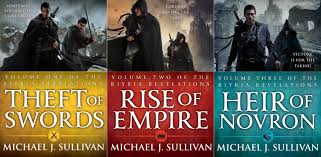
The Riyria Revelation follows the adventures of the unlikely partnership of Hadrian Blackwater and Royce Melbourne. Hadrian is an idealistic swordsman of uncommon skill, possessing the secrets of a legendary warrior caste, while Royce is a cynical thief whose demeanor is as dark as his occupation. If this sounds like a riff on Fafhrd and the Grey Mouser, it's because it is. Sullivan doesn't bother to obscure his use of tropes at all. His thinking seems to be that these archetypes are popular for a reason, and his use of elements familiar to long time fantasy readers doesn't stop with his choice of protagonists. We have elves and dwarves, that are exactly what we expect them to be, an all powerful wizard, a princess that seems fated to fall for one of our heroes, a hidden heir to the throne and more. What makes Sullivan so successful is that he makes no attempt to hide what he is doing and embraces the universality of these elements with an intent to deliver a fast-paced story with likeable characters and nothing more. Focusing on the strength of the characters and knowing exactly what kind of story he intends to tell, gives Sullivan the ability to eliminate the reams of exposition and meandering plot common in most door-stopper fantasy. Sullivan sets out to entertain and while his characters and settings may be all to familiar, he accomplishes his mission with a calculated light touch that is more common to episodic television than most of today's genre fantasy.
Some may criticize the limited scope of Hadrian and Royce's personalities, finding their relationship little more than a sword and sorcery riff on buddy-cop movies like the Lethal Weapon series. And they wouldn't be wrong, but Sullivan makes it work, allowing the effortless and often comedic nature of the relationship between the two to sell itself. We liked Riggs and Murtaugh, and I think that even the most accomplished and cynical fantasy reader will like Hadrian and Royce as well. They bicker and snipe at each other, but underneath is a grudging respect and love for one another that makes reading their adventures like visiting with old friends. More than anywhere else in the series, this is where Sullivan shines.
This is obviously Hadrian and Royce's story, so secondary characters often seem wooden by comparison. Later volumes allow other characters to step into the limelight, and they fair better then, though they never threaten the star status of either the warrior or the thief. Sullivan handles female characters well, when the spotlight focuses on them. Princess Arista and Thrace are standouts in this regard, though I felt that the end of both of their character arcs was predictable if ultimately satisfying.
The plot of the Riyria Revelations starts off simply. Hadrian and Royce accept a job that seems all too easy, to steal a sword from inside the castle of the king. Predictably, they succeed in acquiring the weapon but are caught red handed before they make their escape. The king has been murdered and our heroes are holding the murder weapon. The duo is placed in the dungeon awaiting trial and certain execution, when they are released by the princess Arista who knows they are innocent and frees them to find the true culprit, the only catch they must take her brother, the heir to the throne, with them. The plot grows in complexity from there, with Sullivan adding layers with each volume in the series, but fans of the labyrinthine plotting of Martin or Weeks will find this series all too simplistic if not predictable. But Sullivan's aim isn't to confound you with reversals, switchbacks and red herrings. He simply wants to tell a rousing tale of heroism and daring, not unlike a very well done campaign of Dungeons and Dragons. And he succeeds, Hadrian and Royce are heroic, almost always likeable, and ultimately successful through either their own considerable skills or sheer dumb luck and coincidence. Things progress quickly as the stakes rise and we see more of the world and the characters that populate it. The stakes rise and predictably so do our characters, leveling up to face the rising threat. But the progression makes sense and is ultimately satisfying as we want Royce and Hadrian to do well. Unlike George R. R. Martin, Sullivan gives readers what they want.
Sullivan's prose is as simple and comfortable as his characters and plot, and The Riyria Revelelations reads more like a episodic television show, than a multi-volume epic fantasy series. Given that Sullivan has stated that he writes with the intention of the writer being as invisible as possible, he should be applauded for never does a overly lengthy description or bit of poetic musing distract the reader from the easy, yet consistent flow of the tale. This is Royce and Hadrian's tale and Sullivan never tries to make his own. Everything Sullivan does is in service to the story, and if the story is a throw back to simpler days where the heroes were undeniably heroes, the monsters were destined to be slain, and good is destined to triumph over evil, then Sullivan has more than achieved those ends. It may not be a reflection of the complex and often disappointing world we live in, but I would say that we as a people need fairy tales and Sullivan has provided us with one.
Wolfe was right, you never can go home again. But Micheal Sullivan certainly transports readers to a place so reminiscent of the idealistic adventures of our youth that we don't really mind the difference.
Books don't suffer as badly, at least in my experience. But they do suffer, especially now that fantasy and science fiction are big business that are targeted, not at children, but adults. Seventeen on the top grossing films of all time are directly tied to science fiction and fantasy in some fashion. (Eighteen, if you count The Passion of the Christ, but I'm not opening that can of worms.) It stands to reason, with that much money to be made, both the writers and readers of fantasy and science fiction have grown more sophisticated, making reading some of the earlier mainstays in the genre seem even more dated and passe on a second viewing. Readers of Weiss and Hickman's Dragonlance novels and David Edding's Belgariad and Mallorean series, would likely agree that while these series remain some of the most formative of our early years as fantasy readers, they are definitely not books we would rush to read again or recommend highly when authors like Rothfuss, Martin, and Abercrombie are dominating the charts.
So what does this all have to do with Michael J. Sullivan, author of the self-published and later commercially successful Riyria Revelation series? Sullivan's return to the adventure rich, hopeful, and rollicking themes of those older novels, proves while you may not be able to go "home" again, nostalgia can be used to tell powerful and rewarding stories that don't necessarily fit into the more gritty and adult themed stories that make up the bulk of popular fantasy reading today.
Some may criticize the limited scope of Hadrian and Royce's personalities, finding their relationship little more than a sword and sorcery riff on buddy-cop movies like the Lethal Weapon series. And they wouldn't be wrong, but Sullivan makes it work, allowing the effortless and often comedic nature of the relationship between the two to sell itself. We liked Riggs and Murtaugh, and I think that even the most accomplished and cynical fantasy reader will like Hadrian and Royce as well. They bicker and snipe at each other, but underneath is a grudging respect and love for one another that makes reading their adventures like visiting with old friends. More than anywhere else in the series, this is where Sullivan shines.
This is obviously Hadrian and Royce's story, so secondary characters often seem wooden by comparison. Later volumes allow other characters to step into the limelight, and they fair better then, though they never threaten the star status of either the warrior or the thief. Sullivan handles female characters well, when the spotlight focuses on them. Princess Arista and Thrace are standouts in this regard, though I felt that the end of both of their character arcs was predictable if ultimately satisfying.
The plot of the Riyria Revelations starts off simply. Hadrian and Royce accept a job that seems all too easy, to steal a sword from inside the castle of the king. Predictably, they succeed in acquiring the weapon but are caught red handed before they make their escape. The king has been murdered and our heroes are holding the murder weapon. The duo is placed in the dungeon awaiting trial and certain execution, when they are released by the princess Arista who knows they are innocent and frees them to find the true culprit, the only catch they must take her brother, the heir to the throne, with them. The plot grows in complexity from there, with Sullivan adding layers with each volume in the series, but fans of the labyrinthine plotting of Martin or Weeks will find this series all too simplistic if not predictable. But Sullivan's aim isn't to confound you with reversals, switchbacks and red herrings. He simply wants to tell a rousing tale of heroism and daring, not unlike a very well done campaign of Dungeons and Dragons. And he succeeds, Hadrian and Royce are heroic, almost always likeable, and ultimately successful through either their own considerable skills or sheer dumb luck and coincidence. Things progress quickly as the stakes rise and we see more of the world and the characters that populate it. The stakes rise and predictably so do our characters, leveling up to face the rising threat. But the progression makes sense and is ultimately satisfying as we want Royce and Hadrian to do well. Unlike George R. R. Martin, Sullivan gives readers what they want.
Sullivan's prose is as simple and comfortable as his characters and plot, and The Riyria Revelelations reads more like a episodic television show, than a multi-volume epic fantasy series. Given that Sullivan has stated that he writes with the intention of the writer being as invisible as possible, he should be applauded for never does a overly lengthy description or bit of poetic musing distract the reader from the easy, yet consistent flow of the tale. This is Royce and Hadrian's tale and Sullivan never tries to make his own. Everything Sullivan does is in service to the story, and if the story is a throw back to simpler days where the heroes were undeniably heroes, the monsters were destined to be slain, and good is destined to triumph over evil, then Sullivan has more than achieved those ends. It may not be a reflection of the complex and often disappointing world we live in, but I would say that we as a people need fairy tales and Sullivan has provided us with one.
Wolfe was right, you never can go home again. But Micheal Sullivan certainly transports readers to a place so reminiscent of the idealistic adventures of our youth that we don't really mind the difference.
Wednesday, September 26, 2012
Coming Attractions: The Crown Tower by Michael J. Sullivan
One of the more recent authors to be added to must read list is Michael J. Sullivan. His Riyria Revelations series published last year by Orbit was such a page turner that I finished all three volumes (which actually were omnibuses containing two novels each) in a two week spree. Sullivan's style of accessible sword and sorcery recalls all the best bits of genre legends like the late David Eddings while borrowing heavilly from the structure of genre television standouts like Battlestar Gallactica and Babylon 5. The Crown Tower begins a prequel cycle featuring the protagonists of The Riyria Revelations. I've missed Hadrian and Royce and can't wait to read them again.

And here's the blurb from the publisher:
August of 2013 can't get here soon enough.

And here's the blurb from the publisher:
Two men who hate each other. One impossible mission. A legend in the making.
Hadrian, a warrior with nothing to fight for is paired with a thieving assassin, Royce, with nothing to lose. Together they must steal a treasure that no one can reach. The Crown Tower is the impregnable remains of the grandest fortress ever built and home to the realm’s most prized possessions. But it isn’t gold or jewels that the old wizard is after, and if he can just keep them from killing each other, they just might do it.
August of 2013 can't get here soon enough.
Subscribe to:
Posts (Atom)