 Zombies are a bit of a cultural phenomenon, in case you’ve been living in a cave somewhere. With the success of The Walking Dead there are plenty of novels about the living dead to choose from and I’ll admit to liking more than a few of them. I’d heard of Mira Grant’s Feed earlier in the year, but passed on reading it because it was told after the zombacalypse. I’m a huge fan of end of the world tales and the idea of a novel that was set after the exciting parts were over just didn’t do it for me. But after realizing my own gender bias was brought to my attention, I started seeking out female genre writers and after sampling one of the Seanan McGuire’s (Mira Grant is a pseudonym) other work and enjoying it, I decided to give Feed a go. And despite my earlier misgivings, I couldn’t be happier with this unique and refreshing take on the world post-zombie outbreak. Feed easily ranks as one of the best novels I’ve read this year and it’s taking all of my willpower not to rush out and dive into the rest of the Newsflesh trilogy.
Showing posts with label Horror. Show all posts
Showing posts with label Horror. Show all posts
Monday, December 2, 2013
Feed by Mira Grant
Zombies are a bit of a cultural phenomenon, in case you’ve been living in a cave somewhere. With the success of The Walking Dead there are plenty of novels about the living dead to choose from and I’ll admit to liking more than a few of them. I’d heard of Mira Grant’s Feed earlier in the year, but passed on reading it because it was told after the zombacalypse. I’m a huge fan of end of the world tales and the idea of a novel that was set after the exciting parts were over just didn’t do it for me. But after realizing my own gender bias was brought to my attention, I started seeking out female genre writers and after sampling one of the Seanan McGuire’s (Mira Grant is a pseudonym) other work and enjoying it, I decided to give Feed a go. And despite my earlier misgivings, I couldn’t be happier with this unique and refreshing take on the world post-zombie outbreak. Feed easily ranks as one of the best novels I’ve read this year and it’s taking all of my willpower not to rush out and dive into the rest of the Newsflesh trilogy.
Wednesday, November 6, 2013
NOS4A2 by Joe Hill

I’ve been following Joe Hill’s career since the beginning. As a long term fan of his father, Stephen King, I was curious to see what his son might contribute to my bookshelves. Hill has yet to disappoint. His novels, while not as compelling as some of his father’s standouts, were well written, compelling, and showed a promise of greater things to come. Hill’s latest effort, NOS4A2 is the fulfillment of that promise. Hill has created a novel full of terror, heart ache, and redemption that is a strong contender for the best book I’ve read this year. NOS4A2 fires on all cylinders, and is a thrilling ride from start to finish and is populated with characters so full of life that I found myself putting off the end of the novel, so our time together wouldn’t come to a close. With so many books waiting in the wings, it’s not often that I feel so strongly about a story. It appears, the undoubtedly proud papa should be watching his six, because Junior has definitely arrived.
Tuesday, June 18, 2013
Mayhem by Sarah Pinborough
It's been almost a year since I started this blog, and I am just now starting to see a trickle of review copies coming in from publishers. Jo Fletcher Books, was the first company to send me more than a single title, and Sarah Pinborough's Mayhem was the first to arrive. After the Victorian themed disappointment of The Iron Wyrm Affair, I was a little hesitant to dive into another novel set in London during a similar time period. But Pinborough had me at Jack the Ripper, even though the infamous serial killer serves only as background to the infinitely more interesting tale of another set of grisly murders that were eclipsed by the Whitechapel killings. Pinborough does a superb job of threading historical fact with just the right blend of creeping and unsettling horror producing a novel of exceptional elegance and mood despite the viscera and violence of its premise.
Publisher's back copy follows:
Bond feels a bit like a combination of Sherlock Holmes and his constant companion Dr. John Watson. A Police Surgeon with an uncanny ability to read people as well as their lifeless remains, Dr. Bond is also an opium addict, seeking out seedy opium dens at night for relief from his crushing insomnia and anxiety. Bond is the lens of much of Pinborough's narrative, and his struggles with addiction and the increasing horrors of both Jack the Ripper and the Torso Killer's murders lend the telling a sense of foreboding and brooding intensity. Pinborogh does a wonderful job of showing Bond in various social settings as befits a man of his stature, giving us a view not only of the man haunted by the horrors of his work but the man as seen by his peers, collegues and friends. Bond is not simply a means to supply the truth of the killings, an investigative paper doll, if you will. He is a living, breathng, complex and conflicted person. It is that depth of character that sustains Mayhem during its quiter moments.
As Bond delves deeper into the mystery of the Torso Killer, he finds himself allied with a nameless priest and the fictionalized real life personage of Aaron Kosminski, a suspect judged insane in the investigations of the Ripper murders. Kosminski is afflicted by terrible visions and is linked to the malevolent entity that is responsible for the Torso Murders, and perhaps the Ripper murders by the maddening influence its presence has on London itself. Kosminski and the priests absolute belief in the supernatural nature of the murders is directly at odds with Bond's more rationale approach. This dichotomy as well as the fact that Bond, a respectable gentleman, is now allied with people from such a completely different social strata gives the reader a real sense of the time period. Pinborough shows it all, from high society to gut knotting poverty and as a result London comes alive in the telling, a real character of its own rather than a convienient backdrop for her murder mystery.
Pinborough reveals the identity of the killer at near the halfway mark, and surprisingly it doesn't weaken the tale in the slightest. Most of this is due to her choice to give us the killer's point of view in flashback as he finds himself saddled with a supernatural creature that is slowly driving him mad. The sympathy created in this telling is important and adds to the horror that this "killer" will not be redeemed, and is just one more victim of the entity now haunting London. My only compaint is that the final confrontation could have been a bit more pulse pounding and acton packed, but that wouldn't have fit with the creeping horror and descent into despair and madness that permeates the story. The ending is exactly what it should have been, my minor quibble aside.
Despite the fact that Mayhem works perfectly well as a stand alone novel, I was quite pleased to learn that Pinborough intends to return to Dr. Bond in a sequel. I'm not sure what the future holds for Pinborough's alternate London or her engaging protagonist, but you can rest assured I'll be along for the ride.
Publisher's back copy follows:
A new killer is stalking the streets of London’s East End. Though newspapers have dubbed him ‘the Torso Killer’, this murderer’s work is overshadowed by the hysteria surrounding Jack the Ripper’s Whitechapel crimes.Mayhem, not surprisingly, opens with a murder. Pinborough plays it shrewdly though, focusing in on the fear and confusion of the victim rather than gratuitous blood splatter and screaming, and allowing the reader to catch the smallest of glimpse of the madness gripping this unknown killer. With the initial hook set, we are quickly drawn into the investigation through the eyes of Dr. Thomas Bond.
The victims are women too, but their dismembered bodies, wrapped in rags and tied up with string, are pulled out of the Thames – and the heads are missing. The murderer likes to keep them.
Bond feels a bit like a combination of Sherlock Holmes and his constant companion Dr. John Watson. A Police Surgeon with an uncanny ability to read people as well as their lifeless remains, Dr. Bond is also an opium addict, seeking out seedy opium dens at night for relief from his crushing insomnia and anxiety. Bond is the lens of much of Pinborough's narrative, and his struggles with addiction and the increasing horrors of both Jack the Ripper and the Torso Killer's murders lend the telling a sense of foreboding and brooding intensity. Pinborogh does a wonderful job of showing Bond in various social settings as befits a man of his stature, giving us a view not only of the man haunted by the horrors of his work but the man as seen by his peers, collegues and friends. Bond is not simply a means to supply the truth of the killings, an investigative paper doll, if you will. He is a living, breathng, complex and conflicted person. It is that depth of character that sustains Mayhem during its quiter moments.
As Bond delves deeper into the mystery of the Torso Killer, he finds himself allied with a nameless priest and the fictionalized real life personage of Aaron Kosminski, a suspect judged insane in the investigations of the Ripper murders. Kosminski is afflicted by terrible visions and is linked to the malevolent entity that is responsible for the Torso Murders, and perhaps the Ripper murders by the maddening influence its presence has on London itself. Kosminski and the priests absolute belief in the supernatural nature of the murders is directly at odds with Bond's more rationale approach. This dichotomy as well as the fact that Bond, a respectable gentleman, is now allied with people from such a completely different social strata gives the reader a real sense of the time period. Pinborough shows it all, from high society to gut knotting poverty and as a result London comes alive in the telling, a real character of its own rather than a convienient backdrop for her murder mystery.
Pinborough reveals the identity of the killer at near the halfway mark, and surprisingly it doesn't weaken the tale in the slightest. Most of this is due to her choice to give us the killer's point of view in flashback as he finds himself saddled with a supernatural creature that is slowly driving him mad. The sympathy created in this telling is important and adds to the horror that this "killer" will not be redeemed, and is just one more victim of the entity now haunting London. My only compaint is that the final confrontation could have been a bit more pulse pounding and acton packed, but that wouldn't have fit with the creeping horror and descent into despair and madness that permeates the story. The ending is exactly what it should have been, my minor quibble aside.
Despite the fact that Mayhem works perfectly well as a stand alone novel, I was quite pleased to learn that Pinborough intends to return to Dr. Bond in a sequel. I'm not sure what the future holds for Pinborough's alternate London or her engaging protagonist, but you can rest assured I'll be along for the ride.
Monday, April 29, 2013
Patient Zero by Jonathan Maberry
Jonathan Maberry's name has been popping up on my Twitter feed for months, so I decided to take a look at the first of his Joe Ledger series. Maberry delivers a fast paced, high tension yarn with a memorable protagonist and a compelling supporting cast. Fans of World War Z and television's Burn Notice will likely find Patient Zero right up their alley.

Ledger's fellow soldiers are cut from the same supremely competent cloth, all top-tier operators, real heart breakers and life takers to a man. But despite these similarities, Maberry manages to give just enough depth to make these characters more than simple window dressing. Only Ledger's love interest, Grace Courtland, gets enough quiet character moments to make her more than just another gunslinger. The growing attraction and eventual hook up, while inevitable, is handled with enough class and real world subtlety that it was actually a welcome change of pace from the relentless suspense and violence of the main plot thread. Maberry handles it much more deftly than I would have expected from a novel so full of machismo.
The non-combatants receive even better treatment, particularly Ledger's psychiatrist and close friend, Rudy Sanchez and the head of the DMS, the enigmatic Mr. Church. Sanchez' role as the mouthpiece for Maberry's thoughts about the nature and effects of violence on the psyche give him some of the most thought provoking bits of dialogue, and a real sense of a bystander's react, ion to the horrific nature of both the threat of the bio-weapon and the severity of the necessary response. Church is also a real standout, enigmatic, calculating and ruthless in his pursuit of the terrorist responsible for the virus. Maberry keeps Church a mystery, but allows just enough glimpses of the behind his aloof facade that readers can't help but want to learn more about the head of the DMS.
Despite the masterfully orchestrated action scenes that populate the seeming majority of the novel's pages, I felt the pacing left something to be desired. Though I suspect my own fondness for the Ledger chapters may have contributed to this view. I still believe that the space between the more active and central thread and the more minor thread featuring the antagonists and their plans could have been managed better. But it's a minor quibble really. Especially given the fact that each of the principle characters in that secondary thread are given simple yet complete character arcs. A lesser writer wouldn't have invested the space, but Maberry knows better. This secondary plot line, while not as compelling as that of Ledger and Company, is crucial enough that to hide it behind the scenes would have been criminal.
The action is gritty, rapid fire, blood on the walls violence preceded and followed by longer moments of gripping suspense and the psychological horror that is left in its wake. Maberry doesn't shy away from the trauma faced by soldiers and those who experience horror their minds are ill equipped to process. These explorations into the psyches of the characters and the questions they ask of themselves and each other were the best part of the novel for me, transforming what could have been a simple piece of 'brain candy' into something more satisfying with a far richer and more rewarding flavor. There's a better flavor of brains for this zombie novel and I definitely will be back for seconds.
The real selling point for Patient Zero is the voice of Maberry's protagonist, Joe Ledger. Surprisingly, Maberry chooses to write in third person rather than first, which seems to be a necessary evil since our hero never really shares screen time with the real villains of the piece. But the strength of Ledger's chapters is evident in my exasperation any time I was forced to spend too much time with anyone other than Ledger. Ledger has a lot in common with another popular suspense hero, James Patterson's, Alex Cross. But while Cross seems almost too perfect, Ledger is much more the every man in spite of being perhaps a bit too competent. But I suppose a high degree of competence is required when facing hordes of the walking dead with nothing more than a hand gun. But it's not the sheer amount of Ledger's bad-assery that makes the book, though Maberry has a deft touch with action sequences. It's his particular blend of pissed off sarcasm that really sells the character for me. Joe's a guy you'd be more than happy to have a beer or six with after work.
When you have to kill the same terrorist twice in one week there's either something wrong with your world or something wrong with your skills... and there's nothing wrong with Joe Ledger's skills. And that's both a good, and a bad thing. It's good because he's a Baltimore detective that has just been secretly recruited by the government to lead a new taskforce created to deal with the problems that Homeland Security can't handle. This rapid response group is called the Department of Military Sciences or the DMS for short. It's bad because his first mission is to help stop a group of terrorists from releasing a dreadful bio-weapon that can turn ordinary people into zombies. The fate of the world hangs in the balance....
Ledger's fellow soldiers are cut from the same supremely competent cloth, all top-tier operators, real heart breakers and life takers to a man. But despite these similarities, Maberry manages to give just enough depth to make these characters more than simple window dressing. Only Ledger's love interest, Grace Courtland, gets enough quiet character moments to make her more than just another gunslinger. The growing attraction and eventual hook up, while inevitable, is handled with enough class and real world subtlety that it was actually a welcome change of pace from the relentless suspense and violence of the main plot thread. Maberry handles it much more deftly than I would have expected from a novel so full of machismo.
The non-combatants receive even better treatment, particularly Ledger's psychiatrist and close friend, Rudy Sanchez and the head of the DMS, the enigmatic Mr. Church. Sanchez' role as the mouthpiece for Maberry's thoughts about the nature and effects of violence on the psyche give him some of the most thought provoking bits of dialogue, and a real sense of a bystander's react, ion to the horrific nature of both the threat of the bio-weapon and the severity of the necessary response. Church is also a real standout, enigmatic, calculating and ruthless in his pursuit of the terrorist responsible for the virus. Maberry keeps Church a mystery, but allows just enough glimpses of the behind his aloof facade that readers can't help but want to learn more about the head of the DMS.
Despite the masterfully orchestrated action scenes that populate the seeming majority of the novel's pages, I felt the pacing left something to be desired. Though I suspect my own fondness for the Ledger chapters may have contributed to this view. I still believe that the space between the more active and central thread and the more minor thread featuring the antagonists and their plans could have been managed better. But it's a minor quibble really. Especially given the fact that each of the principle characters in that secondary thread are given simple yet complete character arcs. A lesser writer wouldn't have invested the space, but Maberry knows better. This secondary plot line, while not as compelling as that of Ledger and Company, is crucial enough that to hide it behind the scenes would have been criminal.
The action is gritty, rapid fire, blood on the walls violence preceded and followed by longer moments of gripping suspense and the psychological horror that is left in its wake. Maberry doesn't shy away from the trauma faced by soldiers and those who experience horror their minds are ill equipped to process. These explorations into the psyches of the characters and the questions they ask of themselves and each other were the best part of the novel for me, transforming what could have been a simple piece of 'brain candy' into something more satisfying with a far richer and more rewarding flavor. There's a better flavor of brains for this zombie novel and I definitely will be back for seconds.
Thursday, April 11, 2013
14 by Peter Clines
I've always enjoyed Peter Clines' work, finding his Ex-Heroes and Ex-Patriots to be wildly entertaining mash-ups of the post-apocalytic, horror, and superhero genres. So when I found this title on Netgalley for free, I snatched it up. It's a bit of a departure from Cline's previous work, but as a long time fan of Stephen King, I found the premise interesting.

Padlocked doors. Strange light fixtures. Mutant cockroaches.
There are some odd things about Nate’s new apartment.
Of course, he has other things on his mind. He hates his job. He has no money in the bank. No girlfriend. No plans for the future. So while his new home isn’t perfect, it’s livable. The rent is low, the property managers are friendly, and the odd little mysteries don’t nag at him too much.
At least, not until he meets Mandy, his neighbor across the hall, and notices something unusual about her apartment. And Xela’s apartment. And Tim’s. And Veek’s.
Because every room in this old Los Angeles brownstone has a mystery or two. Mysteries that stretch back over a hundred years. Some of them are in plain sight. Some are behind locked doors. And all together these mysteries could mean the end of Nate and his friends.
Or the end of everything...I think the biggest challenge to reviewing 14 effectively is avoiding spoilers. So much of the action and plot of the story is tied to its many mysteries, that to seperate them makes such examination largely meaningless. There have been comparissons to Lost and these are apt, though I also see similarities to other standout genre shows such as Sanctuary and Warehouse 13. There are secrets, both great and small in almost every aspect of the story, from the motivations of Clines' large cast of characters, to the mysteries of the Kavach building and its history. Much like Lost there is a strong current of misdirection as some mysteries that may seem important are more for flavor than any real plot movement. But the sheer amount of questions and speculation that Clines wrings from the reader are a testament to his skills as a writer.
But the mystery elements are not Clines' only strength. His characterization is the main draw. 14 has a fairly sprawling cast, and Clines gives us a very clear and detailed characterization of each. The banter between characters and the romantic subplots are handled with a deft touch. The realism of these portrayals help ground the otherworldly and often bizarre revelations that are a result of the slow reveal of the building's mysterious purpose.
Being so familiar with the frenetic pacing of Clines' other work, the slower pace of 14 was distracting at first, but the growing suspense as more and more mysteries were answered more than made up for the slower build up. And the last third of the novel definitely stepped on the gas, delivering higher stakes and tension.
In the last fourth of the novel, things take a Lovecraftian turn, and Clines almost lost me. I've never been a big Cthulu fan, but his care in character developments kept me engaged despite my misgivings about his choice of principle antagonists. I'm glad I stayed with it, because the closing sequences were particularly satisfying for me and tease at the possibilty for further exploration of the Kavach building and its residents.
While I enjoyed Ex-Heroes and Ex-Heroes more, I can't deny that Clines knows how to tell a compelling horror story. His gift for characterization makes up for any reticence I felt with regards to other elements of the tale, and I'd definitely come back for more. If you are a fan of big mysteries, full of more questions than answers, then 14 is not a book you should miss. Clines crafts a compelling mystery, populated with characters that feel like the neighbors you wish you had. Think Friends meets The Outer Limits without the laugh track.
Friday, November 9, 2012
Review of the Week: Cycle of the Werewolf by Stephen King
With NaNoWriMo currently kicking my butt, I've found it hard to find the time to read let alone post a review. But since I promise one review a week, I went looking for something short to read and found something that I had been meaning to add to my collection for a while at a used book store while on a visit to Nashville. Stephen King has always been a favorite of mine, and I've read almost everything in his considerable body of work. Cycle of the Werewolf has been one of the holdouts, and I'm glad to report that despite its relatively short length, barely 100 pages, it's definitely worth the read. Adding to the presentation are the fantastic illustrations by Bernie Wrightson, best known for his work on DC Comics Swamp Thing.

Cycle of the Werewolf is the story of the small town of Tarker's Mills and the series of werewolf attacks that plague its citizens over the course of a year. King divides the larger story into twelve smaller short stories, one for each of the months of the year. It is reminiscent in structure to the much more popular The Green Mile, which was released in a similar format but with more significant content in each section of the story.
The first few chapters center on the victims, where King does an excellent job letting us slip into these characters' hearts and minds just moments before their grisly demise. These doomed townspeople are shown to be meaningful and at times you'll find yourself feeling sorry for the lives they have endured, or secretly pleased that they've gotten their just deserts.
We also learn about Tarker's Mills through the seemingly insignificant details scattered throughout the short chapters. King is a master of short stories, able to paint a vivid and meaningful scene in very little space. He wastes no words, often making phrases and descriptions pull double and triple duty addressing character, tone, and theme at the same time.
The werewolf meets his nemesis on July 4th in the form of a paraplegic boy, Marty Coslaw. Marty narrowly escapes being the monster's latest victim and is the first to confirm the rumors that a monster is terrorizing the town, rather than some deranged drifter or local psychopath. Not that anyone takes his account seriously, and he is left to fend for himself. When he discovers the creature is a well respected member of the community a few months later, he concocts a plan to rid Tarker's Mills of the monster for good.
Cycle of the Werewolf is not a complex story, the plot is basic and has very little of the twists and turns of King's longer works. But King's mastery of character and tone make it a work worth reading to anyone who enjoys a well crafted short story. Each 'month' chronicled in the larger arc has something to recommend it, and the way King builds tension, pathos, and setting layer by layer as we move closer to the inevitable confrontation between Coslow and the werewolf is a masterclass on how to do a lot with a little. The price is high, given the amount of actual content, but it is well worth picking up at a used bookstore. King has been awarded the prestigious Medal of Distinguished Contribution to American Letters and while Cycle of the Werewolf is not his most prestigious or familiar work, even in this more obscure and admittedly thin volume you can catch a glimpse at what makes him one of the most popular and celebrated authors in recent history.
Cycle of the Werewolf is the story of the small town of Tarker's Mills and the series of werewolf attacks that plague its citizens over the course of a year. King divides the larger story into twelve smaller short stories, one for each of the months of the year. It is reminiscent in structure to the much more popular The Green Mile, which was released in a similar format but with more significant content in each section of the story.
The first few chapters center on the victims, where King does an excellent job letting us slip into these characters' hearts and minds just moments before their grisly demise. These doomed townspeople are shown to be meaningful and at times you'll find yourself feeling sorry for the lives they have endured, or secretly pleased that they've gotten their just deserts.
We also learn about Tarker's Mills through the seemingly insignificant details scattered throughout the short chapters. King is a master of short stories, able to paint a vivid and meaningful scene in very little space. He wastes no words, often making phrases and descriptions pull double and triple duty addressing character, tone, and theme at the same time.
The werewolf meets his nemesis on July 4th in the form of a paraplegic boy, Marty Coslaw. Marty narrowly escapes being the monster's latest victim and is the first to confirm the rumors that a monster is terrorizing the town, rather than some deranged drifter or local psychopath. Not that anyone takes his account seriously, and he is left to fend for himself. When he discovers the creature is a well respected member of the community a few months later, he concocts a plan to rid Tarker's Mills of the monster for good.
Cycle of the Werewolf is not a complex story, the plot is basic and has very little of the twists and turns of King's longer works. But King's mastery of character and tone make it a work worth reading to anyone who enjoys a well crafted short story. Each 'month' chronicled in the larger arc has something to recommend it, and the way King builds tension, pathos, and setting layer by layer as we move closer to the inevitable confrontation between Coslow and the werewolf is a masterclass on how to do a lot with a little. The price is high, given the amount of actual content, but it is well worth picking up at a used bookstore. King has been awarded the prestigious Medal of Distinguished Contribution to American Letters and while Cycle of the Werewolf is not his most prestigious or familiar work, even in this more obscure and admittedly thin volume you can catch a glimpse at what makes him one of the most popular and celebrated authors in recent history.
Monday, September 24, 2012
Coming Attractions: NOS4R2 by Joe Hill
Joe Hill is one of my favorite authors who isn't specifically a fantasy author. His novels Heart Shaped Box and Horns are both astonishingly visceral and thought-provoking reads. His soon to be completed series of graphic novels Locke and Key are second only to Neil Gaiman's legendary Sandman series. So when I saw the cover art for his upcoming novel NOS4R2, I had to share. So take a peek, and if you aren't reading Joe Hill yet, go directly to your local book seller and give him a shot.

Thursday, August 16, 2012
You Should Be Reading: Dan Wells
I don't usually read Young Adult fiction. I occasionally will check out something that has captured some level of zeitgeist. Harry Potter, Katniss Everdeen and Percy Jackson have a space on my shelves. I hope to recommend these to my children when they are old enough to start reading these kinds of books. Dan Wells has earned a place on the shelf with Rowling, Collins, and Riordan with his fantastic John Wayne Cleaver novels, though I will probably wait until after Rowling and Riordan are familiar names to my children before I introduce them to young John Cleaver.

John Wayne Cleaver has all of the characteristics of a serial killer, and he knows it. He is an expert on the subject. Even his name seems to condemn him to a predetermined fate. His therapist has diagnosed him as a sociopath, and John now lives by a set of rules designed to keep his darker urges at bay. When a killer begins using his small town as a killing ground, John's macabre fascination and the urge of the hunt send him into conflict with just the kind of monster who John seems destined to become.
If this immediately makes you think of Jeff Lindsay's Dexter series, you aren't alone. But John Cleaver isn't Dexter Morgan any more than Dumbledore is Gandalf. Despite the similarities at the surface of the concept, Wells makes it something all his own with the unique, first person voice of his protagonist. The addition of a twist part way through the book this story steps even farther away from Lindsay's wheelhouse.
The main difference between John Cleaver and Dexter Morgan is that while Dexter is a serial killer, albeit one who only kills the guilty, John is determined not to give into his urges. While those who have read beyond the first novel of Wells' series might call that a gross oversimplification, there more concrete differences. We must also consider the difference between the code of conduct that each character follows. Dexter's rules stem from his desire not to be discovered for the monster that he is. John's rules are designed to prevent him from becoming the monster he fears he will eventually become. Also unlike Dexter, John doesn't always succeed in following his code. Like any teen-aged boy, John has to test his limits and Well's wisely chooses to show the consequences to these lapses in judgement. Whether it is continuing to assist in the family-mortuary business, allowing himself to pursue his crush, or putting himself on a collision course with an actual killer, John's flirtations with his darker impulses always complicate matters for our young protagonist.
Through his attempts to stave off his inner monster, we are introduced to a stable of interesting characters who only serve to highlight the problems John's condition causes. By allowing us to view John's fractured relationship with his mother and sister, his awkward courting of his crush, to his tactical choice of a best friend, Wells manages to create a character that is at the same time alien to readers while keeping a him likable and sympathetic narrator. John's lack of empathy coupled with his awareness that he needs to at least try to hide his lack of feelings from everyone around him, makes the young killer in the making a compelling character that readers want to see succeed.
While initially I Am Not A Serial Killer seem like a crime novel, Well's takes us into genre territory by introducing a twist when the killer's identity is revealed. There is not much exposition about the specifics of the sudden game changing revelation, but I think that serves the story well. Teenage killers in waiting, are probably not prone to playing twenty questions with their prey, and John is no exception. What questions he does have prove hard to answer, and Wells feeds the information to us slowly over the course of the series. It keeps the narration honest even if it may frustrate some readers.
While no slouch in the pacing and plot categories, it's Well's gift for character and the uniqueness of John's narrative voice that propels I Am Not A Serial Killer and it's sequels into the ranks of books that I think you should be reading, young adult classification or not.
Tuesday, August 7, 2012
Monster Hunter International by Larry Correia
One of the most common bits of advice for aspiring writers is to write what you know. Larry Correia took that bit of wisdom and ran with it like Jesse Owens. Correia knows guns and b-horror movies and he combines his passions into a novel that reads like a mix of Supernatural and The Dirty Dozen. Monster Hunter International is the first installment in Correia's Monster Hunter series, that as of this writing has two sequels, with a third due out this year. There is also some talk about a role-playing game featuring both the characters and setting of the series. There may not be lots of critical acclaim for the series, but Correia tells an engaging, frenetically paced tale packed with humor, action and memorable characters.
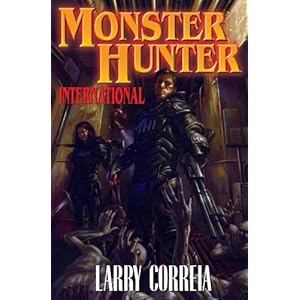
Owen Zastava Pitt is an accountant. Not the typical profession one would normally associate with the protagonist in a book with "hunter" in the title, let alone the word "monster". But when Pitt's boss at his accounting firm turns out to be a werewolf, our protagonist produces a concealed firearm and takes the fight to his insufferable boss. When bullets have no effect, he manages to throw the beast out a window killing it in the multiple story drop. Due to his injuries Owen wakes up in the hospital. he finds out that monsters are real and the government is taking great pains to keep it covered up. The two men in dark suits that come to visit Owen make it absolutely clear that pain is the operative word. But another visit has something else in mind for Owen. His survival against all odds has brought him to the attention of Monster Hunter International, and they have a job for him.
Sounds just like a B-movie, doesn't it? Correia, wisely doesn't try to make the story something that it's not. The cliches are out on proud display. The monsters are for the most part just what you'd expect, there is a prophesy, some dream-walking, and psuedopod who is the really big bad. Corriea doesn't take himself too seriously and it shows. This is a book about killing werewolves and vampires with lots of guns and explosives. It's the side order of cheese that makes it, and Corriea milks it without ever evolving into unintentional satire. Some elitist readers might complain, but I doubt even that. In my experience there aren't many people that don't deep down really love cheese.
In spite of that, Correia manages to elevate his story above its B-movie roots. The characters are surprisingly well drawn. Our narrator, Pitt is a likeable and quirky narrator. While his capabilities are a bit over the top, Correia manages to tie that fact to his back story in a way that in spite of being a little forced doesn't make you groan. The Monster Hunters, who remind me a little of what would happen if Blackwater was staffed by the A-Team, are full of black humor and gung-ho bravado. Many of them seem fairly one note at first, but as their back stories are fleshed out it is easy for readers to find someone to relate to. There are burgeoning friendships, camaraderie, jealousy and grudges aplenty. There is even a significant romantic plot thread that is handled well, even if the object of Owen's desire is something of a go to fantasy for almost every geek out there.
The antagonists while largely straight out of central casting, are more than mustache twirling villains largely due to Corriea's wise use of Pitt's ghost fueled dreams. The monsters are far less interesting than the members of the government's monster control task force charged with policing the hunters and keeping all knowledge of the supernatural from the general populace. The contrasts between the "true believers" in government service and the professional hunters who make scandalous amounts of cash for bringing down monsters of all kinds make for an interesting dichotomy.
The violence is plentiful as are guns of all shapes and sizes. Corriea's knowledge of the subject take center stage here, but he manages to do so without bogging those readers who have little to no knowledge of firearms in the an excess of minutia. Choosing to tell the story from Pitt's viewpoint makes it feel fairly seamless, because the his knowledge mirrors the author's so closely. Action sequences are in your face, loud and flashy, with spent shell casings and explosions in abundance. Many of these sequences would translate well to a summer block buster, and I for one think this story is begging for a translation to a visual media. Readers of the series can feel free to e-mail me to discuss dream casting.
Monster Hunter International excels in all the areas it should, and never makes the mistake for trying to apologize for it. Corriea more than delivers the goods on action, likable characters, and humor while still adding more depth than a reader would have any right to expect given the roots of it's premise. I'll be looking forward to reading more adventures from Pitt and the rest of Monster Hunter International's wild bunch. For now I'm going to whistle the A-Team's theme song and start thinking about my dream movie cast.
Owen Zastava Pitt is an accountant. Not the typical profession one would normally associate with the protagonist in a book with "hunter" in the title, let alone the word "monster". But when Pitt's boss at his accounting firm turns out to be a werewolf, our protagonist produces a concealed firearm and takes the fight to his insufferable boss. When bullets have no effect, he manages to throw the beast out a window killing it in the multiple story drop. Due to his injuries Owen wakes up in the hospital. he finds out that monsters are real and the government is taking great pains to keep it covered up. The two men in dark suits that come to visit Owen make it absolutely clear that pain is the operative word. But another visit has something else in mind for Owen. His survival against all odds has brought him to the attention of Monster Hunter International, and they have a job for him.
Sounds just like a B-movie, doesn't it? Correia, wisely doesn't try to make the story something that it's not. The cliches are out on proud display. The monsters are for the most part just what you'd expect, there is a prophesy, some dream-walking, and psuedopod who is the really big bad. Corriea doesn't take himself too seriously and it shows. This is a book about killing werewolves and vampires with lots of guns and explosives. It's the side order of cheese that makes it, and Corriea milks it without ever evolving into unintentional satire. Some elitist readers might complain, but I doubt even that. In my experience there aren't many people that don't deep down really love cheese.
In spite of that, Correia manages to elevate his story above its B-movie roots. The characters are surprisingly well drawn. Our narrator, Pitt is a likeable and quirky narrator. While his capabilities are a bit over the top, Correia manages to tie that fact to his back story in a way that in spite of being a little forced doesn't make you groan. The Monster Hunters, who remind me a little of what would happen if Blackwater was staffed by the A-Team, are full of black humor and gung-ho bravado. Many of them seem fairly one note at first, but as their back stories are fleshed out it is easy for readers to find someone to relate to. There are burgeoning friendships, camaraderie, jealousy and grudges aplenty. There is even a significant romantic plot thread that is handled well, even if the object of Owen's desire is something of a go to fantasy for almost every geek out there.
The antagonists while largely straight out of central casting, are more than mustache twirling villains largely due to Corriea's wise use of Pitt's ghost fueled dreams. The monsters are far less interesting than the members of the government's monster control task force charged with policing the hunters and keeping all knowledge of the supernatural from the general populace. The contrasts between the "true believers" in government service and the professional hunters who make scandalous amounts of cash for bringing down monsters of all kinds make for an interesting dichotomy.
The violence is plentiful as are guns of all shapes and sizes. Corriea's knowledge of the subject take center stage here, but he manages to do so without bogging those readers who have little to no knowledge of firearms in the an excess of minutia. Choosing to tell the story from Pitt's viewpoint makes it feel fairly seamless, because the his knowledge mirrors the author's so closely. Action sequences are in your face, loud and flashy, with spent shell casings and explosions in abundance. Many of these sequences would translate well to a summer block buster, and I for one think this story is begging for a translation to a visual media. Readers of the series can feel free to e-mail me to discuss dream casting.
Monster Hunter International excels in all the areas it should, and never makes the mistake for trying to apologize for it. Corriea more than delivers the goods on action, likable characters, and humor while still adding more depth than a reader would have any right to expect given the roots of it's premise. I'll be looking forward to reading more adventures from Pitt and the rest of Monster Hunter International's wild bunch. For now I'm going to whistle the A-Team's theme song and start thinking about my dream movie cast.
Subscribe to:
Comments (Atom)