
Showing posts with label YA. Show all posts
Showing posts with label YA. Show all posts
Friday, January 17, 2014
YA Spotlight: Origin by Jessica Khoury

Thursday, August 29, 2013
The Woken Gods by Gwenda Bond

I’m fairly certain that The Woken Gods is only the fourth YA novel I've read this year. But the blurb sounded promising and the idea of gods walking among men seemed close enough to my wheel house to all but guarantee that I would enjoy it, so I took the plunge. After reading, I've decided that the novel is pretty typical of the reasons why I read so little Young Adult fiction, yet continue to dip my toe in the water from time to time. This is not to say that I didn't like the novel. I did. Despite some disconnects, The Woken Gods gets a lot of things right and makes for an interesting and easy read. And there is nothing wrong with that.
Thursday, August 22, 2013
Student Bodies by Sean Cummings
 My experience with Young Adult fiction is pretty limited, and I typically read only the cultural phenomenon books like The Hunger Games and Harry Potter or works by authors I already enjoy, like Chuck Wendig or Dan Wells. However, I choose a few books from Angry Robot’s YA line, Strange Chemistry, as an experiment. Sean Cumming’s Student Bodies is the first of those.
The star of Cumming’s tale is Julie Richardson, high school student and a witch with a surprising amount of magical power. When Julie and her boyfriend, Marcus uncover a supernatural plot to murder students at their high school, they are quickly swept into battle with an ancient evil that could easily destroy their entire town. With a surprisingly diverse cast of allies, Julie and Marcus must uncover the source of the threat and eliminate it, before time runs out.
I was a little disappointed when I realized that Student Bodies was the second installment in a series, with Poltergeekspreceding it. Cummings does an excellent job of making the story work without too much knowledge of what came before. There are plenty of references to the previous volume, but they convey the relevant information in such a way that it doesn’t hinder the pacing or confuse readers who come to the series in the middle, like I did.
Wednesday, June 26, 2013
Under the Empyrean Sky by Chuck Wendig
I first heard of Chuck Wendig's YA novel, Under the Empyrean Sky in the interview I conducted with Chuck after reviewing The Blue Blazes. This is what Chuck had to say about it:

We've seen Chuck's pitch for the novel, but lets take a look at the back copy before we move on.
Cael McAvoy is the epitome of a sixteen year old boy, surly with a complete disregard for authority, capable of both incredible kindness and callous indifference to the feelings of others. Self absorbed is the term that comes immediately to mind, but having been a sixteen year old boy I felt an immediate sense of authenticity to the portrayal. Wendig wisely uses the events of the story to soften the edges of his protagonist, giving both Cael and the reader the sense that Cael's world and the people in it don't fit as neatly into the preconceived boxes the sixteen year old might think. By the end of the novel, there is little doubt that Cael is poised on the brink of his true journey into manhood.
The other characters are equally well drawn and Wendig eventually shifts the point of view in such a way as to illuminate these secondary characters even more fully. Both genders get equal time to shine, with Wendig's portrayal of Cael's love interest showing particular maturity and depth without losing the naivete of youth. I have a feeling that Gwennie Shawcatch will play a major role in later books and can't wait to see what adventures Wendig has in store for her. Cael sister, Merelda is also someone that I'm looking forward to sharing more time with. She gets just enough time in the novel to remain a pleasant cipher readers will look forward to unravelling.
But the real selling point of Under the Empyrean Sky for me was the fantastic job Wendig does of walking the line between the demands of the YA market and the reality of being sixteen. Too many YA books I've read stray so far toward the squeaky clean, that I wonder if the publishers have any idea what it is like to be a teenager. Wendig obviously hasn't forgotten. There is sex, profanity, and senseless bullying. It may not be as gloriously over the top as what Wendig's audience may have grown to expect after books like The Blue Blazes and Blackbirds, but it is there. Even in a YA novel, Wendig manages to still write in a way that doesn't castrate the voice that he's so well known for. He may have tidied it up a bit, but his touch on the pages is unmistakable. And that was the highlight of the experience for me. Seeing one of my favorite authors do something I didn't think they could pull off. In cases like this, I love being wrong.
Under the Empyrean Sky delivers on all levels with a cast of rich characters, a setting that seems limitless in possibility, a message that rides confidently beneath the current of the story and a real understanding of what it is to stand between being a child and an adult, complete with the requisite indecision and ugliness of youth. There's action, adventure, and even a bit of romance in this tale and I'm looking forward to the next installment in the Heartland Trilogy. And I've learned not to scoff at the plans of the incredibly versitile Chuck Wendig.
So I have to be honest, I scoffed at the description, thinking there was no way that Wendig could pull of a novel targeted at a less than mature audience, and wasn't so sure about 'bloodthirsty corn' either. But when I found the title on Netgalley, I just had to give it a run. And, boy was I glad I did. Under the Empyrean Sky is everything that makes YA a powerhouse genre, a coming of age story that resonates with its audience while posing bigger questions for the cross over crowd. There is pathos, mystery, action, and a healthy dose of the bare knuckle prose that makes Wendig such a draw for me. This is no Hunger Games clone, Under the Empyrean Sky brings to mind both the classics like The Grapes of Wrath and mines the Hero monomyth with a rakish glee producing a hybrid much like the aforementioned corn; bloodthirsty and relentless.Under the Empyrean Sky, which is my young adult novel in a sunny dustbowl cornpunk future where a scrappy scavenger named Cael finds a secret forbidden garden in a world where their floating Empyrean overlords only allow them to grow a bloodthirsty variant of corn. It's got young love and adventure and piss-blizzards and motorvators and an agricultural pro-farmer pro-food message nestled in all the trappings. John Hornor Jacobs called it Of Mice and Men meets Star Wars, which I quite like.
We've seen Chuck's pitch for the novel, but lets take a look at the back copy before we move on.
Corn is king in the Heartland, and Cael McAvoy has had enough of it. It's the only crop the Empyrean government allows the people of the Heartland to grow and the genetically modified strain is so aggressive that it takes everything the Heartlanders have just to control it. As captain of the Big Sky Scavengers, Cael and his crew sail their rickety ship over the corn day after day, scavenging for valuables, trying to earn much-needed ace notes for their families. But Cael's tired of surviving life on the ground while the Empyrean elite drift by above in their extravagant sky flotillas. He's sick of the mayor's son besting Cael's crew in the scavenging game. And he's worried about losing Gwennie ? his first mate and the love of his life forever when their government-chosen spouses are revealed. But most of all, Cael is angry, angry that their lot in life will never get better and that his father doesn't seem upset about any of it. Cael's ready to make his own luck . . . even if it means bringing down the wrath of the Empyrean elite and changing life in the Heartland forever.Wendig is obviously aware of the market trends toward dystopian YA novels, as much of the skeletal structure of the novel follows the formula. The stereotypical oppressive government, teen aged protagonists, the beginnings of a love triangle, and the call to arms to fight the rule of the oppressors are all present here. But Wendig wisely turns it on its head, tackling real world issues that may seem too adult for the projected audience. Questions about the control and manipulation of the food that we put into our bodies and the long term effects of monkeying about with Mother Nature are front and center tied closely to the novel's worldbuilding. There are other social issues at play as well, but are much more tangential in this first novel, though I suspect that may change in subsequent volumes. But all of this social activism is handled deftly, with precious little preaching going on, either from the characters or exposition. Social issues may be a thread in the tapestry but Cael's journey for independence and freedom is the focus and that is where the story shines.
Cael McAvoy is the epitome of a sixteen year old boy, surly with a complete disregard for authority, capable of both incredible kindness and callous indifference to the feelings of others. Self absorbed is the term that comes immediately to mind, but having been a sixteen year old boy I felt an immediate sense of authenticity to the portrayal. Wendig wisely uses the events of the story to soften the edges of his protagonist, giving both Cael and the reader the sense that Cael's world and the people in it don't fit as neatly into the preconceived boxes the sixteen year old might think. By the end of the novel, there is little doubt that Cael is poised on the brink of his true journey into manhood.
The other characters are equally well drawn and Wendig eventually shifts the point of view in such a way as to illuminate these secondary characters even more fully. Both genders get equal time to shine, with Wendig's portrayal of Cael's love interest showing particular maturity and depth without losing the naivete of youth. I have a feeling that Gwennie Shawcatch will play a major role in later books and can't wait to see what adventures Wendig has in store for her. Cael sister, Merelda is also someone that I'm looking forward to sharing more time with. She gets just enough time in the novel to remain a pleasant cipher readers will look forward to unravelling.
But the real selling point of Under the Empyrean Sky for me was the fantastic job Wendig does of walking the line between the demands of the YA market and the reality of being sixteen. Too many YA books I've read stray so far toward the squeaky clean, that I wonder if the publishers have any idea what it is like to be a teenager. Wendig obviously hasn't forgotten. There is sex, profanity, and senseless bullying. It may not be as gloriously over the top as what Wendig's audience may have grown to expect after books like The Blue Blazes and Blackbirds, but it is there. Even in a YA novel, Wendig manages to still write in a way that doesn't castrate the voice that he's so well known for. He may have tidied it up a bit, but his touch on the pages is unmistakable. And that was the highlight of the experience for me. Seeing one of my favorite authors do something I didn't think they could pull off. In cases like this, I love being wrong.
Under the Empyrean Sky delivers on all levels with a cast of rich characters, a setting that seems limitless in possibility, a message that rides confidently beneath the current of the story and a real understanding of what it is to stand between being a child and an adult, complete with the requisite indecision and ugliness of youth. There's action, adventure, and even a bit of romance in this tale and I'm looking forward to the next installment in the Heartland Trilogy. And I've learned not to scoff at the plans of the incredibly versitile Chuck Wendig.
Thursday, April 18, 2013
Fragments by Dan Wells
Dan Wells is the only YA author that I read with any regularity. Sure I read the Hunger Games so I could be conversant with the throngs of acquaintances and friends who thought Collins' trilogy was the second coming. Honestly, I much prefer Wells' work, though there are shades of Collins' formula present in his Partials Sequence. I found the first volume, Partials, to be a good if not stellar start to the series, but decided to continue the series based on my experiences with the excellent John Cleaver books. Wells doesn't disappoint at all, with his second installment. Fragments succeeds on every level, easily ratcheting up the momentum from Partials and improves by leaps and bounds leaving me anxious for the continuation of the series.

Removed from the medical setting so prevalent in Partials, I found Kira to be a much more relatable character. Her youth made her proficiency in virology a bit of a strain of credibility, though Wells' manages to shore that up with the revelation of Kira's heritage at the end of that novel. As she explores the mysteries of her own identity and faces not only the perils of travelling in the blighted remains of post-Break America but the complications brought on by her travelling companions.
And what companions they are. Between the mentally unstable tech wizard, Afa and the Partials; Samm and Heron, Kira is pulled in multiple directions for most of the narrative. Afa, in particular, provides an almost bottomless well of story beats and complications. Samm is far more well developed here, as the attraction between he and Kira is further explored. Wells' wisely gives him more screen time, and develops him beyond the more machine than man archetype that he filled in Partials. Heron is an excellent foil for the idealistic Kira. Her pragmatic, 'the end justifies the means' attitude is often at odds with the rest of the companions, and comes to head in the final chapters.
Wells' wisely keeps readers abreast of what is happening in East Meadow, with almost all of the secondary characters from Partials making appearances. Marcus gets the most screen time, and he seems to benefit from being out from under Kira's shadow. I found his deadpan humor and his complete averageness, much more appealing this go around. The twin plot lines, keep the tension well balanced and give Wells plenty of room to explore the various mysteries of both the nature of the Break and the organization and motives of the Partials. I never felt the urge to rush to get to the other section of the novel, with Wells balancing the action and suspense equally over the various plot threads.
The slowly unfolding mystery of the Break and Kira's role in the schemes of ParaGen is the real strength of Fragments. Through this plot device, Wells reveals more and more details not only about the world the cast travels through, but the events leading up to the Break and how those events shaped the current landscape. We are treated not just to New York and it's immediate environs, but to the whole of the Midwest, which is now toxic due to the after effects of massive fires in the Texas oil fields. But more important than the trials of the road, are the moral and ethical puzzles that permeate Kira's internal monologue and much of the conversations between her and her travelling companions.
All in all, Fragments barely feels like a YA novel, especially in terms of its handling of the subject matter. Wells' never turns away from the hard questions, and resists the urge to provide the pat answers. Sure there is a definite lack of realistically described violence, so fans of Abercrombian grit need not apply. There are a few places where I found the sheer young-adult friendly dialogue a bit cringe worthy, as real teenagers would have cursed a blue-streak, but these quibbles are largely forgivable. Wells continues to mature and the intricacies of his plot and nuance of his characterization promise more rousing adventures in this fascinating setting.
Kira Walker has found the cure for RM, but the battle for the survival of humans and Partials is just beginning. Kira has left East Meadow in a desperate search for clues to who she is. That the Partials themselves hold the cure for RM in their blood cannot be a coincidence--it must be part of a larger plan, a plan that involves Kira, a plan that could save both races. Her companions are Afa Demoux, an unhinged drifter and former employee of ParaGen, and Samm and Heron, the Partials who betrayed her and saved her life, the only ones who know her secret. But can she trust them?Wells ups the ante with this volume, immediately removing Kira from the familiar surroundings of East Meadow and her circle of friends. Away from familiar surroundings, Kira begins her exploration of the unsettled areas of Well's post-apocalyptic setting. While the landscape offers very little new to genre readers familiar with similar dystopian settings, the internal monologue that accompanies Kira's exploration is fresh and revealing. Even with the problem of the RM virus, partially solved Kira is surrounded by mysteries both about her own history and the history of the Break that left both the humans and Partials on the edge of extinction.
Meanwhile, back on Long Island, what's left of humanity is gearing up for war with the Partials, and Marcus knows his only hope is to delay them until Kira returns. But Kira's journey will take her deep into the overgrown wasteland of postapocalyptic America, and Kira and Marcus both will discover that their greatest enemy may be one they didn't even know existed.
The second installment in the pulse-pounding Partials saga is the story of the eleventh hour of humanity's time on Earth, a journey deep into places unknown to discover the means--and even more important, a reason--for our survival.
Removed from the medical setting so prevalent in Partials, I found Kira to be a much more relatable character. Her youth made her proficiency in virology a bit of a strain of credibility, though Wells' manages to shore that up with the revelation of Kira's heritage at the end of that novel. As she explores the mysteries of her own identity and faces not only the perils of travelling in the blighted remains of post-Break America but the complications brought on by her travelling companions.
And what companions they are. Between the mentally unstable tech wizard, Afa and the Partials; Samm and Heron, Kira is pulled in multiple directions for most of the narrative. Afa, in particular, provides an almost bottomless well of story beats and complications. Samm is far more well developed here, as the attraction between he and Kira is further explored. Wells' wisely gives him more screen time, and develops him beyond the more machine than man archetype that he filled in Partials. Heron is an excellent foil for the idealistic Kira. Her pragmatic, 'the end justifies the means' attitude is often at odds with the rest of the companions, and comes to head in the final chapters.
Wells' wisely keeps readers abreast of what is happening in East Meadow, with almost all of the secondary characters from Partials making appearances. Marcus gets the most screen time, and he seems to benefit from being out from under Kira's shadow. I found his deadpan humor and his complete averageness, much more appealing this go around. The twin plot lines, keep the tension well balanced and give Wells plenty of room to explore the various mysteries of both the nature of the Break and the organization and motives of the Partials. I never felt the urge to rush to get to the other section of the novel, with Wells balancing the action and suspense equally over the various plot threads.
The slowly unfolding mystery of the Break and Kira's role in the schemes of ParaGen is the real strength of Fragments. Through this plot device, Wells reveals more and more details not only about the world the cast travels through, but the events leading up to the Break and how those events shaped the current landscape. We are treated not just to New York and it's immediate environs, but to the whole of the Midwest, which is now toxic due to the after effects of massive fires in the Texas oil fields. But more important than the trials of the road, are the moral and ethical puzzles that permeate Kira's internal monologue and much of the conversations between her and her travelling companions.
All in all, Fragments barely feels like a YA novel, especially in terms of its handling of the subject matter. Wells' never turns away from the hard questions, and resists the urge to provide the pat answers. Sure there is a definite lack of realistically described violence, so fans of Abercrombian grit need not apply. There are a few places where I found the sheer young-adult friendly dialogue a bit cringe worthy, as real teenagers would have cursed a blue-streak, but these quibbles are largely forgivable. Wells continues to mature and the intricacies of his plot and nuance of his characterization promise more rousing adventures in this fascinating setting.
Monday, September 24, 2012
Coming Attractions: The Rithmatist by Brandon Sanderson
If you mash steampunk, young adult fiction, and the incredible imagination of Brandon Sanderson what do you get? Apparently you get Sanderson's next full length novel due for release some time in 2013. Brandon's publisher, Tor has released the following cover art and blurb for what sounds like something completely different for the epic fantasy mainstay.

You may wonder how a two-dimensional drawing could possibly be a threat. Here’s the answer: Wild Chalklings scurry across the ground like scorpions or land piranhas, and bite chunks out of your feet. At which point you fall to the ground and they swarm you. Enough said.
The Rithmatist is about a 14-year-old kid named Joel who wants desperately to be a Rithmatist. But he wasn’t Chosen, so he doesn’t have the ability to bring chalklings or Rithmatic lines to life. All he can do is watch as The Rithmatist students at Armedius Academy learn the mystical art that he would give anything to practice. Then Rithmatist students start disappearing, kidnapped from their rooms at night, leaving only trails of blood. Joel’s professor asks him to help investigate—putting Joel and his friend Melody on the trail of a discovery that could change Rithmatics—and their world—forever…."
Are you intrigued enough by the concept to delve into this story? Or is Sanderson's track record for excellent enough to guarantee your purchase. I know, I'll be checking it out.
Saturday, August 25, 2012
Review of the Week: Partials by Dan Wells
Imagine my surprise when I see a familiar, yet unexpected name on the cover of promising looking dystopian sci-fi tale in the young adult section of my local book store. And here I was, ready to pigeonhole Dan Wells into the supernatural horror category. Since I loved the John Wayne Cleaver trilogy, I had no problem bringing Partials home.
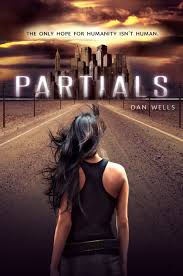
The human race is on the verge of extinction. Eleven years ago, genetically engineered soldiers called partials revolted and decimated the human population, releasing the RM virus that killed not only 99.9% of the population of the United States, but also kills every new child brought into the world. The partials have withdrawn leaving the remaining forty thousand humans trapped in the isolated community of East Meadow in what was Long Island, New York. The humans have rebuilt as best they can, forming a new government, education system and defense force, but the looming spectre of RM infected babies threatens to extinguish all hope for long term survival. The senate institutes the Hope Act, requiring all women under sixteen years of age to have as many children as possible in hopes that a RM resistant child will be born, and a cure can be developed. Predictably, the Hope Act is unpopular giving rise to a revolutionary group known as the Voice who are determined to force its repeal along with other unpopular policies.
Wells opens with our protagonist Kira Walker, a medical intern and virology expert watching yet another newborn die minutes after its birth from the ravages of RM. Kira fears that the Hope Act has little hope of producing an immune child. Convinced that the key to saving the species lies with source of RM, Kira puts together a group of other "plague babies" to travel outside of the safety of East Meadow and capture a partial for study.
With the massive success of Suzanne Collins' Hunger Games trilogy, there was a lot of the premise that felt like ground previously trod, but Wells' manages to turn enough elements on their heads that after just a few chapters I forgot about Katniss, Peeta and crew. Both books feature teen-aged female protagonists, a gritty dystopian future, and a shaky love triangle, but Wells grounds his tale with enough allusions to the world outside the reader's window that East Meadow feels much more tangible than Panem ever does. The political intrigue is well written and reasoned and even the villains both human and partial have a sensible rationale for their behavior.
Our protagonist, Kira, has very little in common with Katniss Everdeen. She is only passibly trained as a soldier and her real contribution to the action is that she is the one that is driving it. Kira's stubborn dedication to making a difference and curing RM is the glue that holds both the plot and her ragtag group of plague babies together. Wells does an excellent job of making Kira and her friends talk like the teenagers they are. They definitely have more adult functions in their society and more life experience than most teenagers in Well's audience, but they banter and moon over the opposite sex often enough that readers will have no trouble seeing themselves in the plague babies. As an adult, some of the more juvenile conversations seem to distract from the plot, but even then Wells keeps these character moments in their proper place, and the pacing never really suffers.
Partials tackles some pretty heavy themes in a way that is accessible for the YA market. The question of when the needs of the society outweigh the rights of the individual is front and center here. The Hope Act, while drafted to address a vital need of the human race, is vastly unpopular and impacts the rights of many of our young heroes. The opinions of Wells' cast are varied and he wisely doesn't pander to one point of view over the other, at least when it comes to the in narrative debates.
Partials concludes in a predictable manner but Wells manages to add more than a few twists and turns along the way, providing a feel good ending with room for future installments. A quick look at Amazon shows another full length novel and an upcoming novella. Based on his first installment, I'd say Wells has another hit series on his hands, and fans of the adventures of young Miss Everdeen, should definitely give this series a look.
The human race is on the verge of extinction. Eleven years ago, genetically engineered soldiers called partials revolted and decimated the human population, releasing the RM virus that killed not only 99.9% of the population of the United States, but also kills every new child brought into the world. The partials have withdrawn leaving the remaining forty thousand humans trapped in the isolated community of East Meadow in what was Long Island, New York. The humans have rebuilt as best they can, forming a new government, education system and defense force, but the looming spectre of RM infected babies threatens to extinguish all hope for long term survival. The senate institutes the Hope Act, requiring all women under sixteen years of age to have as many children as possible in hopes that a RM resistant child will be born, and a cure can be developed. Predictably, the Hope Act is unpopular giving rise to a revolutionary group known as the Voice who are determined to force its repeal along with other unpopular policies.
Wells opens with our protagonist Kira Walker, a medical intern and virology expert watching yet another newborn die minutes after its birth from the ravages of RM. Kira fears that the Hope Act has little hope of producing an immune child. Convinced that the key to saving the species lies with source of RM, Kira puts together a group of other "plague babies" to travel outside of the safety of East Meadow and capture a partial for study.
With the massive success of Suzanne Collins' Hunger Games trilogy, there was a lot of the premise that felt like ground previously trod, but Wells' manages to turn enough elements on their heads that after just a few chapters I forgot about Katniss, Peeta and crew. Both books feature teen-aged female protagonists, a gritty dystopian future, and a shaky love triangle, but Wells grounds his tale with enough allusions to the world outside the reader's window that East Meadow feels much more tangible than Panem ever does. The political intrigue is well written and reasoned and even the villains both human and partial have a sensible rationale for their behavior.
Our protagonist, Kira, has very little in common with Katniss Everdeen. She is only passibly trained as a soldier and her real contribution to the action is that she is the one that is driving it. Kira's stubborn dedication to making a difference and curing RM is the glue that holds both the plot and her ragtag group of plague babies together. Wells does an excellent job of making Kira and her friends talk like the teenagers they are. They definitely have more adult functions in their society and more life experience than most teenagers in Well's audience, but they banter and moon over the opposite sex often enough that readers will have no trouble seeing themselves in the plague babies. As an adult, some of the more juvenile conversations seem to distract from the plot, but even then Wells keeps these character moments in their proper place, and the pacing never really suffers.
Partials tackles some pretty heavy themes in a way that is accessible for the YA market. The question of when the needs of the society outweigh the rights of the individual is front and center here. The Hope Act, while drafted to address a vital need of the human race, is vastly unpopular and impacts the rights of many of our young heroes. The opinions of Wells' cast are varied and he wisely doesn't pander to one point of view over the other, at least when it comes to the in narrative debates.
Partials concludes in a predictable manner but Wells manages to add more than a few twists and turns along the way, providing a feel good ending with room for future installments. A quick look at Amazon shows another full length novel and an upcoming novella. Based on his first installment, I'd say Wells has another hit series on his hands, and fans of the adventures of young Miss Everdeen, should definitely give this series a look.
Thursday, August 16, 2012
You Should Be Reading: Dan Wells
I don't usually read Young Adult fiction. I occasionally will check out something that has captured some level of zeitgeist. Harry Potter, Katniss Everdeen and Percy Jackson have a space on my shelves. I hope to recommend these to my children when they are old enough to start reading these kinds of books. Dan Wells has earned a place on the shelf with Rowling, Collins, and Riordan with his fantastic John Wayne Cleaver novels, though I will probably wait until after Rowling and Riordan are familiar names to my children before I introduce them to young John Cleaver.

John Wayne Cleaver has all of the characteristics of a serial killer, and he knows it. He is an expert on the subject. Even his name seems to condemn him to a predetermined fate. His therapist has diagnosed him as a sociopath, and John now lives by a set of rules designed to keep his darker urges at bay. When a killer begins using his small town as a killing ground, John's macabre fascination and the urge of the hunt send him into conflict with just the kind of monster who John seems destined to become.
If this immediately makes you think of Jeff Lindsay's Dexter series, you aren't alone. But John Cleaver isn't Dexter Morgan any more than Dumbledore is Gandalf. Despite the similarities at the surface of the concept, Wells makes it something all his own with the unique, first person voice of his protagonist. The addition of a twist part way through the book this story steps even farther away from Lindsay's wheelhouse.
The main difference between John Cleaver and Dexter Morgan is that while Dexter is a serial killer, albeit one who only kills the guilty, John is determined not to give into his urges. While those who have read beyond the first novel of Wells' series might call that a gross oversimplification, there more concrete differences. We must also consider the difference between the code of conduct that each character follows. Dexter's rules stem from his desire not to be discovered for the monster that he is. John's rules are designed to prevent him from becoming the monster he fears he will eventually become. Also unlike Dexter, John doesn't always succeed in following his code. Like any teen-aged boy, John has to test his limits and Well's wisely chooses to show the consequences to these lapses in judgement. Whether it is continuing to assist in the family-mortuary business, allowing himself to pursue his crush, or putting himself on a collision course with an actual killer, John's flirtations with his darker impulses always complicate matters for our young protagonist.
Through his attempts to stave off his inner monster, we are introduced to a stable of interesting characters who only serve to highlight the problems John's condition causes. By allowing us to view John's fractured relationship with his mother and sister, his awkward courting of his crush, to his tactical choice of a best friend, Wells manages to create a character that is at the same time alien to readers while keeping a him likable and sympathetic narrator. John's lack of empathy coupled with his awareness that he needs to at least try to hide his lack of feelings from everyone around him, makes the young killer in the making a compelling character that readers want to see succeed.
While initially I Am Not A Serial Killer seem like a crime novel, Well's takes us into genre territory by introducing a twist when the killer's identity is revealed. There is not much exposition about the specifics of the sudden game changing revelation, but I think that serves the story well. Teenage killers in waiting, are probably not prone to playing twenty questions with their prey, and John is no exception. What questions he does have prove hard to answer, and Wells feeds the information to us slowly over the course of the series. It keeps the narration honest even if it may frustrate some readers.
While no slouch in the pacing and plot categories, it's Well's gift for character and the uniqueness of John's narrative voice that propels I Am Not A Serial Killer and it's sequels into the ranks of books that I think you should be reading, young adult classification or not.
Subscribe to:
Posts (Atom)