
Showing posts with label Dystopian. Show all posts
Showing posts with label Dystopian. Show all posts
Thursday, December 5, 2013
The Bone Season by Samantha Shannon

Friday, July 5, 2013
Shift By Hugh Howey
Hugh Howey's Wool was one of the first books outside of epic fantasy that I reviewed, and I was blown away by his claustrophobic tale of the remnants of humanity living below the earth in silos for so long that their inhabitants had forgotten the world above. Howey's blend of science fiction and literary realism was a standout of 2012 for me, so as I approached the first anniversary of this blog, I decided to delve into the second offering in the world of the silos.
While Howey still turns in an atmospherical tale within the pages of Shift, I found it underwhelming in comparison to his earlier work. There was a, pardon the pun, a shift from the sci fi elements into a stronger lit fiction feel, and I found the result well written, but ultimately a trifle unsatisfying.

The publisher's synopsis follows:
Not the most exciting synopsis, is it? I would have passed on this based on the cover art and back copy, if I hadn't been so impressed by Wool. But poor marketing aside, Shift is, on it's face, a welcome addition to Howey's flagship franchise. With it's structure following the same format as it's predecessor, made up of sepearate novellas all connected either through events of reoccuring characters, Shift will feel comfortably familiar to those who devoured Wool.
The first novella introduces us to Donald, a freshman Congressman, who is swiftly entangled in the construction of the silos and the conspiracy behind their true purpose. While Donald is sympathetic and well drawn character, I couldn't help but be appalled at the over all lack of agency he seems to have in this opening novella. I know this is intentional, as Donald is embroiled in circumstances so far beyond his understanding and control that he is simply swept along on its currents. Donald seems to react far more than he ever acts and because of this I found his initial character arc, which is the core of the first novella less than satisfying. I realize that the entire purpose of Shift is to fill in the origin of the silos, but with the foreknowledge that comes with having already read Wool, I couldn't bring myself to care enough about that origin with a protagonist that comes off as milquetoast as Donald.
The second novella, which splits time between Donald and a young porter named Mission Jones, is far better and I found myself wishing that his story was the central thread. Mission's tale centers around the collapse of one of the silo's and shows not only Mission's growing understanding of the silo politics and his questioning of the 'survival of the fittest' philosophy that is at the crux of the silo project. Donald appears here as well and we learn first hand what measures that the architects of the silos will go to keep their experiment going. It's a chilling and poignant tale and in my opinion was the strongest of the novellas included in the omnibus.
The final novella shows what happens when Donald, who by all appearances is the moral compass of the overarching plot of the collection, is placed in charge of the silos. Donald's decent into petty revenge is, while understandable and realistic, largely unsatisfying. The secondary plot, which takes us back in time to follow young Jimmy Parker, who appears in Wool was more palatable at least to me. Seeing the youngster adapt to the crushing lonliness and sporadic violence of the collapse of his silo was both heart wrenching and beautifully executed. This is what Howey does best, creating characters that his readers can empathize with and that manage to survive with nothing more than their strength of character. Jimmy's encroaching madness is well handled and makes the boy's survival all the more heart wrenching. Howey also teases the intersection of Donald and Juliette's story lines for the final volume of the Silo saga, the upcoming Dust.
While I found Shift to lack the suspense and surprise of Wool, there is no denying the emotional heft and deft examination of survival and community in Howey's work. I suspect that the challenges of writing a prequel to such an engaging property are monumental and probably contributed to what felt quite a lot like 'middle book syndromwe' to me. Nevertheless I'll tune in for Dust because I suspect the showdown between Juliette and Donald to be far more satisfying than this look back at the origins of the Silos.
While Howey still turns in an atmospherical tale within the pages of Shift, I found it underwhelming in comparison to his earlier work. There was a, pardon the pun, a shift from the sci fi elements into a stronger lit fiction feel, and I found the result well written, but ultimately a trifle unsatisfying.
The publisher's synopsis follows:
In 2007, the Center for Automation in Nanobiotech (CAN) outlined the hardware and software platform that would one day allow robots smaller than human cells to make medical diagnoses, conduct repairs, and even self-propagate.
In the same year, the CBS network re-aired a program about the effects of propranolol on sufferers of extreme trauma. A simple pill, it had been discovered, could wipe out the memory of any traumatic event.
At almost the same moment in humanity’s broad history, mankind had discovered the means for bringing about its utter downfall. And the ability to forget it ever happened.
Not the most exciting synopsis, is it? I would have passed on this based on the cover art and back copy, if I hadn't been so impressed by Wool. But poor marketing aside, Shift is, on it's face, a welcome addition to Howey's flagship franchise. With it's structure following the same format as it's predecessor, made up of sepearate novellas all connected either through events of reoccuring characters, Shift will feel comfortably familiar to those who devoured Wool.
The first novella introduces us to Donald, a freshman Congressman, who is swiftly entangled in the construction of the silos and the conspiracy behind their true purpose. While Donald is sympathetic and well drawn character, I couldn't help but be appalled at the over all lack of agency he seems to have in this opening novella. I know this is intentional, as Donald is embroiled in circumstances so far beyond his understanding and control that he is simply swept along on its currents. Donald seems to react far more than he ever acts and because of this I found his initial character arc, which is the core of the first novella less than satisfying. I realize that the entire purpose of Shift is to fill in the origin of the silos, but with the foreknowledge that comes with having already read Wool, I couldn't bring myself to care enough about that origin with a protagonist that comes off as milquetoast as Donald.
The second novella, which splits time between Donald and a young porter named Mission Jones, is far better and I found myself wishing that his story was the central thread. Mission's tale centers around the collapse of one of the silo's and shows not only Mission's growing understanding of the silo politics and his questioning of the 'survival of the fittest' philosophy that is at the crux of the silo project. Donald appears here as well and we learn first hand what measures that the architects of the silos will go to keep their experiment going. It's a chilling and poignant tale and in my opinion was the strongest of the novellas included in the omnibus.
The final novella shows what happens when Donald, who by all appearances is the moral compass of the overarching plot of the collection, is placed in charge of the silos. Donald's decent into petty revenge is, while understandable and realistic, largely unsatisfying. The secondary plot, which takes us back in time to follow young Jimmy Parker, who appears in Wool was more palatable at least to me. Seeing the youngster adapt to the crushing lonliness and sporadic violence of the collapse of his silo was both heart wrenching and beautifully executed. This is what Howey does best, creating characters that his readers can empathize with and that manage to survive with nothing more than their strength of character. Jimmy's encroaching madness is well handled and makes the boy's survival all the more heart wrenching. Howey also teases the intersection of Donald and Juliette's story lines for the final volume of the Silo saga, the upcoming Dust.
While I found Shift to lack the suspense and surprise of Wool, there is no denying the emotional heft and deft examination of survival and community in Howey's work. I suspect that the challenges of writing a prequel to such an engaging property are monumental and probably contributed to what felt quite a lot like 'middle book syndromwe' to me. Nevertheless I'll tune in for Dust because I suspect the showdown between Juliette and Donald to be far more satisfying than this look back at the origins of the Silos.
Wednesday, June 26, 2013
Under the Empyrean Sky by Chuck Wendig
I first heard of Chuck Wendig's YA novel, Under the Empyrean Sky in the interview I conducted with Chuck after reviewing The Blue Blazes. This is what Chuck had to say about it:

We've seen Chuck's pitch for the novel, but lets take a look at the back copy before we move on.
Cael McAvoy is the epitome of a sixteen year old boy, surly with a complete disregard for authority, capable of both incredible kindness and callous indifference to the feelings of others. Self absorbed is the term that comes immediately to mind, but having been a sixteen year old boy I felt an immediate sense of authenticity to the portrayal. Wendig wisely uses the events of the story to soften the edges of his protagonist, giving both Cael and the reader the sense that Cael's world and the people in it don't fit as neatly into the preconceived boxes the sixteen year old might think. By the end of the novel, there is little doubt that Cael is poised on the brink of his true journey into manhood.
The other characters are equally well drawn and Wendig eventually shifts the point of view in such a way as to illuminate these secondary characters even more fully. Both genders get equal time to shine, with Wendig's portrayal of Cael's love interest showing particular maturity and depth without losing the naivete of youth. I have a feeling that Gwennie Shawcatch will play a major role in later books and can't wait to see what adventures Wendig has in store for her. Cael sister, Merelda is also someone that I'm looking forward to sharing more time with. She gets just enough time in the novel to remain a pleasant cipher readers will look forward to unravelling.
But the real selling point of Under the Empyrean Sky for me was the fantastic job Wendig does of walking the line between the demands of the YA market and the reality of being sixteen. Too many YA books I've read stray so far toward the squeaky clean, that I wonder if the publishers have any idea what it is like to be a teenager. Wendig obviously hasn't forgotten. There is sex, profanity, and senseless bullying. It may not be as gloriously over the top as what Wendig's audience may have grown to expect after books like The Blue Blazes and Blackbirds, but it is there. Even in a YA novel, Wendig manages to still write in a way that doesn't castrate the voice that he's so well known for. He may have tidied it up a bit, but his touch on the pages is unmistakable. And that was the highlight of the experience for me. Seeing one of my favorite authors do something I didn't think they could pull off. In cases like this, I love being wrong.
Under the Empyrean Sky delivers on all levels with a cast of rich characters, a setting that seems limitless in possibility, a message that rides confidently beneath the current of the story and a real understanding of what it is to stand between being a child and an adult, complete with the requisite indecision and ugliness of youth. There's action, adventure, and even a bit of romance in this tale and I'm looking forward to the next installment in the Heartland Trilogy. And I've learned not to scoff at the plans of the incredibly versitile Chuck Wendig.
So I have to be honest, I scoffed at the description, thinking there was no way that Wendig could pull of a novel targeted at a less than mature audience, and wasn't so sure about 'bloodthirsty corn' either. But when I found the title on Netgalley, I just had to give it a run. And, boy was I glad I did. Under the Empyrean Sky is everything that makes YA a powerhouse genre, a coming of age story that resonates with its audience while posing bigger questions for the cross over crowd. There is pathos, mystery, action, and a healthy dose of the bare knuckle prose that makes Wendig such a draw for me. This is no Hunger Games clone, Under the Empyrean Sky brings to mind both the classics like The Grapes of Wrath and mines the Hero monomyth with a rakish glee producing a hybrid much like the aforementioned corn; bloodthirsty and relentless.Under the Empyrean Sky, which is my young adult novel in a sunny dustbowl cornpunk future where a scrappy scavenger named Cael finds a secret forbidden garden in a world where their floating Empyrean overlords only allow them to grow a bloodthirsty variant of corn. It's got young love and adventure and piss-blizzards and motorvators and an agricultural pro-farmer pro-food message nestled in all the trappings. John Hornor Jacobs called it Of Mice and Men meets Star Wars, which I quite like.
We've seen Chuck's pitch for the novel, but lets take a look at the back copy before we move on.
Corn is king in the Heartland, and Cael McAvoy has had enough of it. It's the only crop the Empyrean government allows the people of the Heartland to grow and the genetically modified strain is so aggressive that it takes everything the Heartlanders have just to control it. As captain of the Big Sky Scavengers, Cael and his crew sail their rickety ship over the corn day after day, scavenging for valuables, trying to earn much-needed ace notes for their families. But Cael's tired of surviving life on the ground while the Empyrean elite drift by above in their extravagant sky flotillas. He's sick of the mayor's son besting Cael's crew in the scavenging game. And he's worried about losing Gwennie ? his first mate and the love of his life forever when their government-chosen spouses are revealed. But most of all, Cael is angry, angry that their lot in life will never get better and that his father doesn't seem upset about any of it. Cael's ready to make his own luck . . . even if it means bringing down the wrath of the Empyrean elite and changing life in the Heartland forever.Wendig is obviously aware of the market trends toward dystopian YA novels, as much of the skeletal structure of the novel follows the formula. The stereotypical oppressive government, teen aged protagonists, the beginnings of a love triangle, and the call to arms to fight the rule of the oppressors are all present here. But Wendig wisely turns it on its head, tackling real world issues that may seem too adult for the projected audience. Questions about the control and manipulation of the food that we put into our bodies and the long term effects of monkeying about with Mother Nature are front and center tied closely to the novel's worldbuilding. There are other social issues at play as well, but are much more tangential in this first novel, though I suspect that may change in subsequent volumes. But all of this social activism is handled deftly, with precious little preaching going on, either from the characters or exposition. Social issues may be a thread in the tapestry but Cael's journey for independence and freedom is the focus and that is where the story shines.
Cael McAvoy is the epitome of a sixteen year old boy, surly with a complete disregard for authority, capable of both incredible kindness and callous indifference to the feelings of others. Self absorbed is the term that comes immediately to mind, but having been a sixteen year old boy I felt an immediate sense of authenticity to the portrayal. Wendig wisely uses the events of the story to soften the edges of his protagonist, giving both Cael and the reader the sense that Cael's world and the people in it don't fit as neatly into the preconceived boxes the sixteen year old might think. By the end of the novel, there is little doubt that Cael is poised on the brink of his true journey into manhood.
The other characters are equally well drawn and Wendig eventually shifts the point of view in such a way as to illuminate these secondary characters even more fully. Both genders get equal time to shine, with Wendig's portrayal of Cael's love interest showing particular maturity and depth without losing the naivete of youth. I have a feeling that Gwennie Shawcatch will play a major role in later books and can't wait to see what adventures Wendig has in store for her. Cael sister, Merelda is also someone that I'm looking forward to sharing more time with. She gets just enough time in the novel to remain a pleasant cipher readers will look forward to unravelling.
But the real selling point of Under the Empyrean Sky for me was the fantastic job Wendig does of walking the line between the demands of the YA market and the reality of being sixteen. Too many YA books I've read stray so far toward the squeaky clean, that I wonder if the publishers have any idea what it is like to be a teenager. Wendig obviously hasn't forgotten. There is sex, profanity, and senseless bullying. It may not be as gloriously over the top as what Wendig's audience may have grown to expect after books like The Blue Blazes and Blackbirds, but it is there. Even in a YA novel, Wendig manages to still write in a way that doesn't castrate the voice that he's so well known for. He may have tidied it up a bit, but his touch on the pages is unmistakable. And that was the highlight of the experience for me. Seeing one of my favorite authors do something I didn't think they could pull off. In cases like this, I love being wrong.
Under the Empyrean Sky delivers on all levels with a cast of rich characters, a setting that seems limitless in possibility, a message that rides confidently beneath the current of the story and a real understanding of what it is to stand between being a child and an adult, complete with the requisite indecision and ugliness of youth. There's action, adventure, and even a bit of romance in this tale and I'm looking forward to the next installment in the Heartland Trilogy. And I've learned not to scoff at the plans of the incredibly versitile Chuck Wendig.
Thursday, April 18, 2013
Fragments by Dan Wells
Dan Wells is the only YA author that I read with any regularity. Sure I read the Hunger Games so I could be conversant with the throngs of acquaintances and friends who thought Collins' trilogy was the second coming. Honestly, I much prefer Wells' work, though there are shades of Collins' formula present in his Partials Sequence. I found the first volume, Partials, to be a good if not stellar start to the series, but decided to continue the series based on my experiences with the excellent John Cleaver books. Wells doesn't disappoint at all, with his second installment. Fragments succeeds on every level, easily ratcheting up the momentum from Partials and improves by leaps and bounds leaving me anxious for the continuation of the series.

Removed from the medical setting so prevalent in Partials, I found Kira to be a much more relatable character. Her youth made her proficiency in virology a bit of a strain of credibility, though Wells' manages to shore that up with the revelation of Kira's heritage at the end of that novel. As she explores the mysteries of her own identity and faces not only the perils of travelling in the blighted remains of post-Break America but the complications brought on by her travelling companions.
And what companions they are. Between the mentally unstable tech wizard, Afa and the Partials; Samm and Heron, Kira is pulled in multiple directions for most of the narrative. Afa, in particular, provides an almost bottomless well of story beats and complications. Samm is far more well developed here, as the attraction between he and Kira is further explored. Wells' wisely gives him more screen time, and develops him beyond the more machine than man archetype that he filled in Partials. Heron is an excellent foil for the idealistic Kira. Her pragmatic, 'the end justifies the means' attitude is often at odds with the rest of the companions, and comes to head in the final chapters.
Wells' wisely keeps readers abreast of what is happening in East Meadow, with almost all of the secondary characters from Partials making appearances. Marcus gets the most screen time, and he seems to benefit from being out from under Kira's shadow. I found his deadpan humor and his complete averageness, much more appealing this go around. The twin plot lines, keep the tension well balanced and give Wells plenty of room to explore the various mysteries of both the nature of the Break and the organization and motives of the Partials. I never felt the urge to rush to get to the other section of the novel, with Wells balancing the action and suspense equally over the various plot threads.
The slowly unfolding mystery of the Break and Kira's role in the schemes of ParaGen is the real strength of Fragments. Through this plot device, Wells reveals more and more details not only about the world the cast travels through, but the events leading up to the Break and how those events shaped the current landscape. We are treated not just to New York and it's immediate environs, but to the whole of the Midwest, which is now toxic due to the after effects of massive fires in the Texas oil fields. But more important than the trials of the road, are the moral and ethical puzzles that permeate Kira's internal monologue and much of the conversations between her and her travelling companions.
All in all, Fragments barely feels like a YA novel, especially in terms of its handling of the subject matter. Wells' never turns away from the hard questions, and resists the urge to provide the pat answers. Sure there is a definite lack of realistically described violence, so fans of Abercrombian grit need not apply. There are a few places where I found the sheer young-adult friendly dialogue a bit cringe worthy, as real teenagers would have cursed a blue-streak, but these quibbles are largely forgivable. Wells continues to mature and the intricacies of his plot and nuance of his characterization promise more rousing adventures in this fascinating setting.
Kira Walker has found the cure for RM, but the battle for the survival of humans and Partials is just beginning. Kira has left East Meadow in a desperate search for clues to who she is. That the Partials themselves hold the cure for RM in their blood cannot be a coincidence--it must be part of a larger plan, a plan that involves Kira, a plan that could save both races. Her companions are Afa Demoux, an unhinged drifter and former employee of ParaGen, and Samm and Heron, the Partials who betrayed her and saved her life, the only ones who know her secret. But can she trust them?Wells ups the ante with this volume, immediately removing Kira from the familiar surroundings of East Meadow and her circle of friends. Away from familiar surroundings, Kira begins her exploration of the unsettled areas of Well's post-apocalyptic setting. While the landscape offers very little new to genre readers familiar with similar dystopian settings, the internal monologue that accompanies Kira's exploration is fresh and revealing. Even with the problem of the RM virus, partially solved Kira is surrounded by mysteries both about her own history and the history of the Break that left both the humans and Partials on the edge of extinction.
Meanwhile, back on Long Island, what's left of humanity is gearing up for war with the Partials, and Marcus knows his only hope is to delay them until Kira returns. But Kira's journey will take her deep into the overgrown wasteland of postapocalyptic America, and Kira and Marcus both will discover that their greatest enemy may be one they didn't even know existed.
The second installment in the pulse-pounding Partials saga is the story of the eleventh hour of humanity's time on Earth, a journey deep into places unknown to discover the means--and even more important, a reason--for our survival.
Removed from the medical setting so prevalent in Partials, I found Kira to be a much more relatable character. Her youth made her proficiency in virology a bit of a strain of credibility, though Wells' manages to shore that up with the revelation of Kira's heritage at the end of that novel. As she explores the mysteries of her own identity and faces not only the perils of travelling in the blighted remains of post-Break America but the complications brought on by her travelling companions.
And what companions they are. Between the mentally unstable tech wizard, Afa and the Partials; Samm and Heron, Kira is pulled in multiple directions for most of the narrative. Afa, in particular, provides an almost bottomless well of story beats and complications. Samm is far more well developed here, as the attraction between he and Kira is further explored. Wells' wisely gives him more screen time, and develops him beyond the more machine than man archetype that he filled in Partials. Heron is an excellent foil for the idealistic Kira. Her pragmatic, 'the end justifies the means' attitude is often at odds with the rest of the companions, and comes to head in the final chapters.
Wells' wisely keeps readers abreast of what is happening in East Meadow, with almost all of the secondary characters from Partials making appearances. Marcus gets the most screen time, and he seems to benefit from being out from under Kira's shadow. I found his deadpan humor and his complete averageness, much more appealing this go around. The twin plot lines, keep the tension well balanced and give Wells plenty of room to explore the various mysteries of both the nature of the Break and the organization and motives of the Partials. I never felt the urge to rush to get to the other section of the novel, with Wells balancing the action and suspense equally over the various plot threads.
The slowly unfolding mystery of the Break and Kira's role in the schemes of ParaGen is the real strength of Fragments. Through this plot device, Wells reveals more and more details not only about the world the cast travels through, but the events leading up to the Break and how those events shaped the current landscape. We are treated not just to New York and it's immediate environs, but to the whole of the Midwest, which is now toxic due to the after effects of massive fires in the Texas oil fields. But more important than the trials of the road, are the moral and ethical puzzles that permeate Kira's internal monologue and much of the conversations between her and her travelling companions.
All in all, Fragments barely feels like a YA novel, especially in terms of its handling of the subject matter. Wells' never turns away from the hard questions, and resists the urge to provide the pat answers. Sure there is a definite lack of realistically described violence, so fans of Abercrombian grit need not apply. There are a few places where I found the sheer young-adult friendly dialogue a bit cringe worthy, as real teenagers would have cursed a blue-streak, but these quibbles are largely forgivable. Wells continues to mature and the intricacies of his plot and nuance of his characterization promise more rousing adventures in this fascinating setting.
Thursday, October 11, 2012
Review of the Week: Stormdancer by Jay Kristoff
Jay Kristoff's debut novel Stormdancer, entered the market on a cloud of positive buzz, helped by a fantastic premise and a cover blurb by none other than Patrick Rothfuss. It was the strength of both that prompted my purchase, and I am certain I am not alone. An endorsement from one of the most highly regarded new voices in the genre in the last decade carries a lot of weight. Sadly, I was left wondering if Rothfuss actually read the entirety of the novel.

The premise of Stormdancer is definitely unique. Kristoff's Shima is Japanese flavored steampunk full of chain-saw katanas, a power mad emperor, samurai wearing mechanized armor, airships and did I mention a griffin. The excitement surrounding this novel is no surprise at all. It seemed almost guaranteed greatness. While it has, no doubt, sold very well, critical reception has been very mixed. This seems to be one of those you love it or you hate it books. Casual readers will likely enjoy the engaging world and characters that populate Stormdancer. Readers with a more critical bent, may have a drastically different experience.
I fell into the latter category. For as many things as Stormdancer has going for it, it has just as many problems. Strength of premise and a fantastic pre-release buzz were just not enough to elevate this story beyond the myriad of problems I encountered. Stormdancer is flawed on so many levels that I was unable to enjoy the story Kristoff was trying to tell. Between the uneven pacing, inconsistent world building, unbelievable character development, and cultural appropriation I had a really hard time even finishing it. Which is sad, because I really wanted to like Stormdancer.
The uneven pacing seems to be the most telling of the early flaws in the novel. Kristoff starts with an action packed sequence, showing us not only our protagonist, Yukiko, but the arashitora or thunder tiger fighting a pair of demons. The action is tight and flows well, and there are just enough hints to make us wonder about how this sixteen year old girl ended up fighting side by side with a mythological beast. If the following chapters were written half as well as the first chapter, Kristoff wouldn't be facing the torrent of criticism that seems to surround Stormdancer. But he doesn't, rewinding the story and launching into chapter after chapter of exposition with very little exciting forward movement. I slogged through the first 120 pages or so. After that, things pick up speed, but there is no gradual ratcheting up of the pace here. We go from coasting along to breakneck speed, and things never really slow down until we are at the final pages.
This causes problems, because character arcs are shortened, keeping them from developing naturally. The two most egregious examples are the relationship between Yukiko and Buruu, the aforementioned arashitora. When Yukiko's father captures Buruu, he cuts off the arashitora's flight feathers in an attempt to break the beast's spirit. Through Yukiko's link with the creature, we are privy to its thoughts. Understandably, they are not charitable at all. But it takes no time at all for Buruu to learn to trust and even love Yukiko though their psychic bond. Kristoff isn't so foolish as to make it a complete about face, but he spends so little time working through the process that the relationship seems contrived and this caused it to ring false at least for me. The second instance that I found particularly off-putting was Yukiko's relationship with the Hiro, the samurai with the green eyes. I'll talk more about the eye color later, but having Yukiko who seems to swoon over this non-character for reasons that are more juvenile than can be attributed to this otherwise resourceful and competent young woman. The relationship like Yukiko's relationship with Buruu moves too quickly and seems to only be there to set up a love triangle and to tell us repeatedly how our heroine knows she is being a foolish girl before continuing to moon over the green-eyed samurai. Given more time these relationships could have been more believable and meaningful, but at the pace Kristoff is setting they come off as shallow and uneven.
The world building in Stormdancer is equally haphazard. While Kristoff has said in interviews that Shima is not Japan, his statements hold no water with me. The language(when he gets it right), cultural norms, weapons, clothing, food, and all of the creatures we encounter(with the exception of the arashitora) are all taken straight from Japan. I'm not an expert on Japanese culture, but with twenty years served as an instructor and student of Japanese martial traditions, I think I am more than qualified to say that if Kristoff wanted this to be Japanese inspired rather than a Japan that never was, he should have tried harder. With that said, the non Japanese elements contained in the story are jarring because the setting is so richly infused with all things Japanese. There are pandas in Shima, and characters use Chinese phrases and a lot of British slang to name but a few of the standouts. These elements stand out so much that they ripped me out of the story and left me scratching my head. In a barely three hundred page novel, these things detract for more than they might have spread out over more pages. Packed so closely together, they just make the writer look lazy.
Which brings me to the issue that seems to be the biggest sticking point with reviewers, cultural appropriation. As I've stated above, there is little use in denying that Kristoff has borrowed or appropriated most of the elements of his setting from Japan. It stands to reason that it is important to treat the borrowed culture with respect, and try to portray it as accurately as possible. I know it's a fantasy story, but if you want to run rough shod over a culture, invent your own. Kristoff seems to pay little attention to accuracy in the language especially in the correct use of honorific terms. In other passages, he has characters translate their own language into English in the midst of internal dialogue. His treatment of women and the caste system of Japanese society is uneven, he uses the correct approach only when it suits him. For example, women are portrayed as subservient to men in almost every setting in the book, except when dealing our protagonist or members of her family. Yukiko is also obviously a member of the samurai caste, given her families long service to the Emperor, yet she seems to be not allowed to wear the swords that would be her birthright. And then there is the green-eyed samurai. Native Japanese do not have such eye color, and to use such a feature to make him somehow more desirable is an insult to the culture that Kristoff owes his entire setting to. It's sloppy writing and with all of the other flaws made Stormdancer a major disappointment, especially given the hype and possibilities of it's premise.
I'm certain Stormdancer will sell plenty of copies, and there will be countless casual readers who will eagerly gobble up anything else Kristoff publishes in this series. And that's okay, I won't be one of them until I see evidence that he's found a way to balance the cool of the story with a whole lot more craft.
The premise of Stormdancer is definitely unique. Kristoff's Shima is Japanese flavored steampunk full of chain-saw katanas, a power mad emperor, samurai wearing mechanized armor, airships and did I mention a griffin. The excitement surrounding this novel is no surprise at all. It seemed almost guaranteed greatness. While it has, no doubt, sold very well, critical reception has been very mixed. This seems to be one of those you love it or you hate it books. Casual readers will likely enjoy the engaging world and characters that populate Stormdancer. Readers with a more critical bent, may have a drastically different experience.
I fell into the latter category. For as many things as Stormdancer has going for it, it has just as many problems. Strength of premise and a fantastic pre-release buzz were just not enough to elevate this story beyond the myriad of problems I encountered. Stormdancer is flawed on so many levels that I was unable to enjoy the story Kristoff was trying to tell. Between the uneven pacing, inconsistent world building, unbelievable character development, and cultural appropriation I had a really hard time even finishing it. Which is sad, because I really wanted to like Stormdancer.
The uneven pacing seems to be the most telling of the early flaws in the novel. Kristoff starts with an action packed sequence, showing us not only our protagonist, Yukiko, but the arashitora or thunder tiger fighting a pair of demons. The action is tight and flows well, and there are just enough hints to make us wonder about how this sixteen year old girl ended up fighting side by side with a mythological beast. If the following chapters were written half as well as the first chapter, Kristoff wouldn't be facing the torrent of criticism that seems to surround Stormdancer. But he doesn't, rewinding the story and launching into chapter after chapter of exposition with very little exciting forward movement. I slogged through the first 120 pages or so. After that, things pick up speed, but there is no gradual ratcheting up of the pace here. We go from coasting along to breakneck speed, and things never really slow down until we are at the final pages.
This causes problems, because character arcs are shortened, keeping them from developing naturally. The two most egregious examples are the relationship between Yukiko and Buruu, the aforementioned arashitora. When Yukiko's father captures Buruu, he cuts off the arashitora's flight feathers in an attempt to break the beast's spirit. Through Yukiko's link with the creature, we are privy to its thoughts. Understandably, they are not charitable at all. But it takes no time at all for Buruu to learn to trust and even love Yukiko though their psychic bond. Kristoff isn't so foolish as to make it a complete about face, but he spends so little time working through the process that the relationship seems contrived and this caused it to ring false at least for me. The second instance that I found particularly off-putting was Yukiko's relationship with the Hiro, the samurai with the green eyes. I'll talk more about the eye color later, but having Yukiko who seems to swoon over this non-character for reasons that are more juvenile than can be attributed to this otherwise resourceful and competent young woman. The relationship like Yukiko's relationship with Buruu moves too quickly and seems to only be there to set up a love triangle and to tell us repeatedly how our heroine knows she is being a foolish girl before continuing to moon over the green-eyed samurai. Given more time these relationships could have been more believable and meaningful, but at the pace Kristoff is setting they come off as shallow and uneven.
The world building in Stormdancer is equally haphazard. While Kristoff has said in interviews that Shima is not Japan, his statements hold no water with me. The language(when he gets it right), cultural norms, weapons, clothing, food, and all of the creatures we encounter(with the exception of the arashitora) are all taken straight from Japan. I'm not an expert on Japanese culture, but with twenty years served as an instructor and student of Japanese martial traditions, I think I am more than qualified to say that if Kristoff wanted this to be Japanese inspired rather than a Japan that never was, he should have tried harder. With that said, the non Japanese elements contained in the story are jarring because the setting is so richly infused with all things Japanese. There are pandas in Shima, and characters use Chinese phrases and a lot of British slang to name but a few of the standouts. These elements stand out so much that they ripped me out of the story and left me scratching my head. In a barely three hundred page novel, these things detract for more than they might have spread out over more pages. Packed so closely together, they just make the writer look lazy.
I'm certain Stormdancer will sell plenty of copies, and there will be countless casual readers who will eagerly gobble up anything else Kristoff publishes in this series. And that's okay, I won't be one of them until I see evidence that he's found a way to balance the cool of the story with a whole lot more craft.
Thursday, September 13, 2012
Review of the Week: Wool by Hugh Howey
I love discovering new authors. It's something of a talent of mine. The Science Fiction Book Club used to help with this, exposing me to countless new authors early enough that I was often in the know about breaking books long before any of my genre minded friends. It probably helped that I read far more than most of the people in my social circle and my voracious appetite for words simply encourages my literary gluttony. But the heyday of the SFBC seems to be gone, and I see less and less new authors with mid-listers gone after just one book. So I've switched to review blogs like the excellent Staffer's Musings and Amazon. I found Hugh Howey's Wool Omnibus on Amazon for a steal and quickly dove in to his tale of a subterranean dystopia. Originally started as a series of self published novellas, Wool has gone on to win critical acclaim and has been optioned for the big screen by none other than Ridley Scott. Not that I knew any of that when I made my purchase, but I can't say I was surprised to find out about Howey's success.
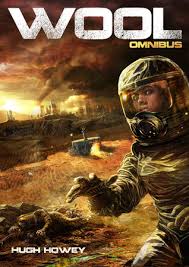
Wool is set in a subterranean silo with hundreds of levels. Within the silo reside the survivors of an unknown apocalypse generations past that rendered the surface of Earth hostile to human life. Our story begins with Sheriff Halston, who has decided to commit suicide by going outside to clean. Being sent to clean is the equivalent of capital punishment in silo society. Criminals of the worst sort and all those who speak of going outside are sent outside the silo to clean the sensors that provide the only view of the outside world. Holston's wife demanded to go outside years ago, and Holston has never understood her reasons. his questions regarding her sudden change in mental state along with his long standing grief lead him to resign as Sherrif and be sent outside. When he steps outside, he is met with an unexpected sight but his protective suit fails like all others have before leaving him to die next to the withered remains of his beloved.
This opening volume of the omnibus was obviously designed as a short story and leaves the reader with more questions than answers, but Howey manages to inject Holston with enough gravitas and depth that it never feels like a cheap parlor trick. Howey's depth of characterization and choice to reveal critical information slowly keeps the reader engaged and makes for page churning pace. If I hadn't been on a vacation full of site-seeing and fantastic food, I would have finished Wool much sooner. However, my slower than usual pace allowed me to savor the world and characters of Wool and I find myself grateful for the opportunity.
The story continues with the silo's mayor travelling to the lowest depths of the structure to enlist a lowly mechanic to take the place of the deceased sheriff. Her decent by means of the central staircase that runs through the silo with the dead man's deputy gives readers a thorough understanding of life on the silo but never reads like an info dump or travelogue. Howey injects this sequence with purpose and depth by telling us about the potential sheriff through the mayor's stops to interview both her estranged father and the head of the silo's IT department who has objections to her potential appointment. Underlying all of this character and world building is a tale of yearning and romance long denied between the aging travelers. Throw in a surprise poisoning and all of the cogs of this dystopian mystery are in place to ratchet up the speed.
Newly appointed Sheriff Juliette has her hands full with a murder investigation and her own questions about her predecessor's choice to clean. She is up against the new interim-mayor and head of IT. She quickly discovers she is in over her head as she discovers a conspiracy that, if revealed, will change the lives of everyone in the silo forever. Powerful forces are aligned against her and she finds herself removed from her new position and sent back to the bowels of the silo. Determined to get to the truth, Juliette puts herself in great peril and soon finds herself sent out to clean.
Howey's characters have the same guaranteed life expectancy of George R. R, Martin's and he makes good use of this tension, leaving you to wonder when and if our heroes will meet an untimely end. And like Martin, he makes each of these characters deep enough that we always care what happens to them. Add in the fact that there is nothing heroic about these characters other than their resolve, decency, and strength and you have something extraordinary in genre fiction. There is a sense of realism in this story that many tales of this type lack. All of Howey's characters respond in ways that resonate with the reader because they like us are all too human. That is the biggest of Wool's considerable strengths.
Howey also manages to keep readers guessing, by revealing key bits of information that, while not always unexpected or shocking, always change the landscape of the story in new and interesting ways. His action sequences are rarely explosive but are almost always pulse pounding and tense. He manages to keep readers on the edge of their metaphorical seat much like James Cameron's classic Aliens. He milks claustrophobia in new an unexpected ways, especially given the underground setting of the silo.
Pacing is solid, ratcheting up after the first two installments that are sadly much shorter than the last. There is a drag in pace in the last volume, but that is largely do to its much larger size than the preceding volumes. I didn't find it distracting at all, because of my attachment to the characters and Howey's skill at world building and starkly beautiful prose. For a guy who didn't have an agent or a publisher when he first published these novellas, Howey has nowhere to go but up.
If you aren't convinced that you should read Wool yet, let me ask you a question. Answer that and you'll have your decision. Do you like to read? If the answer is yes, buy this book. Word has it the first volume, at least, is free.
Wool is set in a subterranean silo with hundreds of levels. Within the silo reside the survivors of an unknown apocalypse generations past that rendered the surface of Earth hostile to human life. Our story begins with Sheriff Halston, who has decided to commit suicide by going outside to clean. Being sent to clean is the equivalent of capital punishment in silo society. Criminals of the worst sort and all those who speak of going outside are sent outside the silo to clean the sensors that provide the only view of the outside world. Holston's wife demanded to go outside years ago, and Holston has never understood her reasons. his questions regarding her sudden change in mental state along with his long standing grief lead him to resign as Sherrif and be sent outside. When he steps outside, he is met with an unexpected sight but his protective suit fails like all others have before leaving him to die next to the withered remains of his beloved.
This opening volume of the omnibus was obviously designed as a short story and leaves the reader with more questions than answers, but Howey manages to inject Holston with enough gravitas and depth that it never feels like a cheap parlor trick. Howey's depth of characterization and choice to reveal critical information slowly keeps the reader engaged and makes for page churning pace. If I hadn't been on a vacation full of site-seeing and fantastic food, I would have finished Wool much sooner. However, my slower than usual pace allowed me to savor the world and characters of Wool and I find myself grateful for the opportunity.
The story continues with the silo's mayor travelling to the lowest depths of the structure to enlist a lowly mechanic to take the place of the deceased sheriff. Her decent by means of the central staircase that runs through the silo with the dead man's deputy gives readers a thorough understanding of life on the silo but never reads like an info dump or travelogue. Howey injects this sequence with purpose and depth by telling us about the potential sheriff through the mayor's stops to interview both her estranged father and the head of the silo's IT department who has objections to her potential appointment. Underlying all of this character and world building is a tale of yearning and romance long denied between the aging travelers. Throw in a surprise poisoning and all of the cogs of this dystopian mystery are in place to ratchet up the speed.
Newly appointed Sheriff Juliette has her hands full with a murder investigation and her own questions about her predecessor's choice to clean. She is up against the new interim-mayor and head of IT. She quickly discovers she is in over her head as she discovers a conspiracy that, if revealed, will change the lives of everyone in the silo forever. Powerful forces are aligned against her and she finds herself removed from her new position and sent back to the bowels of the silo. Determined to get to the truth, Juliette puts herself in great peril and soon finds herself sent out to clean.
Howey's characters have the same guaranteed life expectancy of George R. R, Martin's and he makes good use of this tension, leaving you to wonder when and if our heroes will meet an untimely end. And like Martin, he makes each of these characters deep enough that we always care what happens to them. Add in the fact that there is nothing heroic about these characters other than their resolve, decency, and strength and you have something extraordinary in genre fiction. There is a sense of realism in this story that many tales of this type lack. All of Howey's characters respond in ways that resonate with the reader because they like us are all too human. That is the biggest of Wool's considerable strengths.
Howey also manages to keep readers guessing, by revealing key bits of information that, while not always unexpected or shocking, always change the landscape of the story in new and interesting ways. His action sequences are rarely explosive but are almost always pulse pounding and tense. He manages to keep readers on the edge of their metaphorical seat much like James Cameron's classic Aliens. He milks claustrophobia in new an unexpected ways, especially given the underground setting of the silo.
Pacing is solid, ratcheting up after the first two installments that are sadly much shorter than the last. There is a drag in pace in the last volume, but that is largely do to its much larger size than the preceding volumes. I didn't find it distracting at all, because of my attachment to the characters and Howey's skill at world building and starkly beautiful prose. For a guy who didn't have an agent or a publisher when he first published these novellas, Howey has nowhere to go but up.
If you aren't convinced that you should read Wool yet, let me ask you a question. Answer that and you'll have your decision. Do you like to read? If the answer is yes, buy this book. Word has it the first volume, at least, is free.
Saturday, August 25, 2012
Review of the Week: Partials by Dan Wells
Imagine my surprise when I see a familiar, yet unexpected name on the cover of promising looking dystopian sci-fi tale in the young adult section of my local book store. And here I was, ready to pigeonhole Dan Wells into the supernatural horror category. Since I loved the John Wayne Cleaver trilogy, I had no problem bringing Partials home.
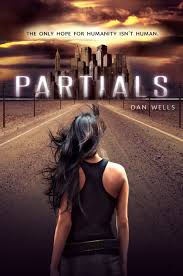
The human race is on the verge of extinction. Eleven years ago, genetically engineered soldiers called partials revolted and decimated the human population, releasing the RM virus that killed not only 99.9% of the population of the United States, but also kills every new child brought into the world. The partials have withdrawn leaving the remaining forty thousand humans trapped in the isolated community of East Meadow in what was Long Island, New York. The humans have rebuilt as best they can, forming a new government, education system and defense force, but the looming spectre of RM infected babies threatens to extinguish all hope for long term survival. The senate institutes the Hope Act, requiring all women under sixteen years of age to have as many children as possible in hopes that a RM resistant child will be born, and a cure can be developed. Predictably, the Hope Act is unpopular giving rise to a revolutionary group known as the Voice who are determined to force its repeal along with other unpopular policies.
Wells opens with our protagonist Kira Walker, a medical intern and virology expert watching yet another newborn die minutes after its birth from the ravages of RM. Kira fears that the Hope Act has little hope of producing an immune child. Convinced that the key to saving the species lies with source of RM, Kira puts together a group of other "plague babies" to travel outside of the safety of East Meadow and capture a partial for study.
With the massive success of Suzanne Collins' Hunger Games trilogy, there was a lot of the premise that felt like ground previously trod, but Wells' manages to turn enough elements on their heads that after just a few chapters I forgot about Katniss, Peeta and crew. Both books feature teen-aged female protagonists, a gritty dystopian future, and a shaky love triangle, but Wells grounds his tale with enough allusions to the world outside the reader's window that East Meadow feels much more tangible than Panem ever does. The political intrigue is well written and reasoned and even the villains both human and partial have a sensible rationale for their behavior.
Our protagonist, Kira, has very little in common with Katniss Everdeen. She is only passibly trained as a soldier and her real contribution to the action is that she is the one that is driving it. Kira's stubborn dedication to making a difference and curing RM is the glue that holds both the plot and her ragtag group of plague babies together. Wells does an excellent job of making Kira and her friends talk like the teenagers they are. They definitely have more adult functions in their society and more life experience than most teenagers in Well's audience, but they banter and moon over the opposite sex often enough that readers will have no trouble seeing themselves in the plague babies. As an adult, some of the more juvenile conversations seem to distract from the plot, but even then Wells keeps these character moments in their proper place, and the pacing never really suffers.
Partials tackles some pretty heavy themes in a way that is accessible for the YA market. The question of when the needs of the society outweigh the rights of the individual is front and center here. The Hope Act, while drafted to address a vital need of the human race, is vastly unpopular and impacts the rights of many of our young heroes. The opinions of Wells' cast are varied and he wisely doesn't pander to one point of view over the other, at least when it comes to the in narrative debates.
Partials concludes in a predictable manner but Wells manages to add more than a few twists and turns along the way, providing a feel good ending with room for future installments. A quick look at Amazon shows another full length novel and an upcoming novella. Based on his first installment, I'd say Wells has another hit series on his hands, and fans of the adventures of young Miss Everdeen, should definitely give this series a look.
The human race is on the verge of extinction. Eleven years ago, genetically engineered soldiers called partials revolted and decimated the human population, releasing the RM virus that killed not only 99.9% of the population of the United States, but also kills every new child brought into the world. The partials have withdrawn leaving the remaining forty thousand humans trapped in the isolated community of East Meadow in what was Long Island, New York. The humans have rebuilt as best they can, forming a new government, education system and defense force, but the looming spectre of RM infected babies threatens to extinguish all hope for long term survival. The senate institutes the Hope Act, requiring all women under sixteen years of age to have as many children as possible in hopes that a RM resistant child will be born, and a cure can be developed. Predictably, the Hope Act is unpopular giving rise to a revolutionary group known as the Voice who are determined to force its repeal along with other unpopular policies.
Wells opens with our protagonist Kira Walker, a medical intern and virology expert watching yet another newborn die minutes after its birth from the ravages of RM. Kira fears that the Hope Act has little hope of producing an immune child. Convinced that the key to saving the species lies with source of RM, Kira puts together a group of other "plague babies" to travel outside of the safety of East Meadow and capture a partial for study.
With the massive success of Suzanne Collins' Hunger Games trilogy, there was a lot of the premise that felt like ground previously trod, but Wells' manages to turn enough elements on their heads that after just a few chapters I forgot about Katniss, Peeta and crew. Both books feature teen-aged female protagonists, a gritty dystopian future, and a shaky love triangle, but Wells grounds his tale with enough allusions to the world outside the reader's window that East Meadow feels much more tangible than Panem ever does. The political intrigue is well written and reasoned and even the villains both human and partial have a sensible rationale for their behavior.
Our protagonist, Kira, has very little in common with Katniss Everdeen. She is only passibly trained as a soldier and her real contribution to the action is that she is the one that is driving it. Kira's stubborn dedication to making a difference and curing RM is the glue that holds both the plot and her ragtag group of plague babies together. Wells does an excellent job of making Kira and her friends talk like the teenagers they are. They definitely have more adult functions in their society and more life experience than most teenagers in Well's audience, but they banter and moon over the opposite sex often enough that readers will have no trouble seeing themselves in the plague babies. As an adult, some of the more juvenile conversations seem to distract from the plot, but even then Wells keeps these character moments in their proper place, and the pacing never really suffers.
Partials tackles some pretty heavy themes in a way that is accessible for the YA market. The question of when the needs of the society outweigh the rights of the individual is front and center here. The Hope Act, while drafted to address a vital need of the human race, is vastly unpopular and impacts the rights of many of our young heroes. The opinions of Wells' cast are varied and he wisely doesn't pander to one point of view over the other, at least when it comes to the in narrative debates.
Partials concludes in a predictable manner but Wells manages to add more than a few twists and turns along the way, providing a feel good ending with room for future installments. A quick look at Amazon shows another full length novel and an upcoming novella. Based on his first installment, I'd say Wells has another hit series on his hands, and fans of the adventures of young Miss Everdeen, should definitely give this series a look.
Friday, August 10, 2012
Audio Files: Ready Player One by Ernest Cline
Ready Player One has been described as a "nerdgasm" by John Scalzi, and has garnered the kind of ardent praise and outright love from the genre community that most authors can only dream about. Cline's novel is a love letter to pop culture and those of us who revel in it. But unlike many other works that only appeal to a specific audience, Cline layers his tale with plenty of vintage goodies for geeks and non-geeks alike. Add in the pitch-perfect narration of Wil Weaton, no stranger to the subject matter, and an already fantastic story is elevated to something akin to a nostalgic trip to geek Valhalla.

The year is 2044, and we find our protagonist Wade Watts living a grim existence. The age of excess and plenty has passed, and all but the rich live in squalor and soul crushing poverty. But this dystopian cloud has a silver lining, the OASIS. Like most of the world's populace, Wade spends almost every waking minute of his life inside the simulation, escaping the harsh realities of his real-world existence.
The OASIS is a bleeding edge Internet that is free for all. It is equal parts MMO, virtual reality simulation, and operating system. Created by James Halliday, a reclusive, anti-social genius, the OASIS is now the primary means for communication, commerce, education, and entertainment. Anything the imagination can create can be found and explored by putting on your gloves and visor and logging in. Upon Halliday's death, his will proclaims that his entire fortune, including control of the OASIS will pass to the winner of the Contest. The Contest is a quest for an Easter Egg hidden within the his creation. A series of keys and gates have been scattered throughout the countless worlds of the OASIS. The secret to succeeding in this quest is hidden in Halliday's passion for the movies, television, music, and video games of his childhood in the 1980's.
Five years after Halliday's death, not a single key or gate has been found. Egg-hunters or 'gunters' as they come to be called, obsess over every obscure reference in Halliday's journal determined to find the first key. Corporate hunters employed by communications giant IOI, called 'sixers' are also in the search, to gain control of the OASIS so that their masters can turn the once free platform into a commercial theme park for the rich. Everything changes when Wade finds the first key. A deadly race ensues where Wade must not only deal with the dangers and mysteries of the Contest within the OASIS but finds himself on the run from IOI agents who are not afraid to bribe, threaten, or murder if it means finding the key.
The story is told in first person through the eyes of Wade Watts, high school student, third level warrior, and gunter known as Parzival in the OASIS. Wade's extensive knowledge of all things 80's is on full display as are his quick wit and intelligence. Wil Wheaton brings it in the audio presentation, personifying the snark and vulnerability of the teenage Wade with ease. His own experiences as a self-proclaimed geek and growing up in the 80's himself lends his narration an undeniable air of authenticity. We are treated to references about everything from Family Ties, War Games, Dungeons and Dragons, and 8-bit video games. A spirited argument about the cinematic value of Lady Hawke was a highlight, complete with the perfect mix of good-natured ribbing and absolute seriousness. Wade and Wheaton are such a perfect match, it is hard to imagine anyone else as the voice of the gunter.
Cline wisely doesn't ignore the psychological issues stemming from Wade's life of isolation or those common to teenagers everywhere. His social anxiety is best mined through his budding romance with fellow gunter and eventual ally Atr3mis. Their conversations are among my favorite passages in the novel; awkward, earnest, and all too true to life. As the hunt for Halliday's egg grows more dangerous, and Wade is forced to spend more and more time out of the OASIS, he begins to experience a growing sense of agoraphobia, showing the dark side of the glittering escapism of the virtual world.
The supporting characters are handled well, particularly Aech, Wade's best friend, and Art3mis, his love interest. Interactions between the trio are among the best passages of the novel and Wheaton handles the banter well. It is easy to imagine that he has similar conversations with his own circle of friends. Cline plays some expected games with the concept of persona versus reality when the action moves out of the OASIS in the last third of the novel, but manages to avoid being pedantic or throwing previous characterization out the window as nothing more than lies.
The OASIS is simply genius as a setting and is almost a character in and of itself. Cline creates a world where the constraints of genre are obliterated, allowing him to mine popular culture with impunity. Imagine a place where you can have armor clad knights and spell slinging mages fighting side by side with thirty foot tall robots against the lions of Voltron and Godzilla. The OASIS is that place and any other place you love from movies, video games and literature. Cline wisely chooses to show a little bit of everything, and never has to bother disguising it.
While full of vast cinematic battles full of spells, bullets, and mechanized warriors and lower key ones like playing video games against a lich (my personal favorite), Ready Player One is a story about growing up. Wade finds that despite all the flash and spectacle of the OASIS that he must become more Wade Watts than Parzival in order to achieve his goal of finding Halliday's Egg. As it turns out, the real world is not so bad after all.
The year is 2044, and we find our protagonist Wade Watts living a grim existence. The age of excess and plenty has passed, and all but the rich live in squalor and soul crushing poverty. But this dystopian cloud has a silver lining, the OASIS. Like most of the world's populace, Wade spends almost every waking minute of his life inside the simulation, escaping the harsh realities of his real-world existence.
The OASIS is a bleeding edge Internet that is free for all. It is equal parts MMO, virtual reality simulation, and operating system. Created by James Halliday, a reclusive, anti-social genius, the OASIS is now the primary means for communication, commerce, education, and entertainment. Anything the imagination can create can be found and explored by putting on your gloves and visor and logging in. Upon Halliday's death, his will proclaims that his entire fortune, including control of the OASIS will pass to the winner of the Contest. The Contest is a quest for an Easter Egg hidden within the his creation. A series of keys and gates have been scattered throughout the countless worlds of the OASIS. The secret to succeeding in this quest is hidden in Halliday's passion for the movies, television, music, and video games of his childhood in the 1980's.
Five years after Halliday's death, not a single key or gate has been found. Egg-hunters or 'gunters' as they come to be called, obsess over every obscure reference in Halliday's journal determined to find the first key. Corporate hunters employed by communications giant IOI, called 'sixers' are also in the search, to gain control of the OASIS so that their masters can turn the once free platform into a commercial theme park for the rich. Everything changes when Wade finds the first key. A deadly race ensues where Wade must not only deal with the dangers and mysteries of the Contest within the OASIS but finds himself on the run from IOI agents who are not afraid to bribe, threaten, or murder if it means finding the key.
The story is told in first person through the eyes of Wade Watts, high school student, third level warrior, and gunter known as Parzival in the OASIS. Wade's extensive knowledge of all things 80's is on full display as are his quick wit and intelligence. Wil Wheaton brings it in the audio presentation, personifying the snark and vulnerability of the teenage Wade with ease. His own experiences as a self-proclaimed geek and growing up in the 80's himself lends his narration an undeniable air of authenticity. We are treated to references about everything from Family Ties, War Games, Dungeons and Dragons, and 8-bit video games. A spirited argument about the cinematic value of Lady Hawke was a highlight, complete with the perfect mix of good-natured ribbing and absolute seriousness. Wade and Wheaton are such a perfect match, it is hard to imagine anyone else as the voice of the gunter.
Cline wisely doesn't ignore the psychological issues stemming from Wade's life of isolation or those common to teenagers everywhere. His social anxiety is best mined through his budding romance with fellow gunter and eventual ally Atr3mis. Their conversations are among my favorite passages in the novel; awkward, earnest, and all too true to life. As the hunt for Halliday's egg grows more dangerous, and Wade is forced to spend more and more time out of the OASIS, he begins to experience a growing sense of agoraphobia, showing the dark side of the glittering escapism of the virtual world.
The supporting characters are handled well, particularly Aech, Wade's best friend, and Art3mis, his love interest. Interactions between the trio are among the best passages of the novel and Wheaton handles the banter well. It is easy to imagine that he has similar conversations with his own circle of friends. Cline plays some expected games with the concept of persona versus reality when the action moves out of the OASIS in the last third of the novel, but manages to avoid being pedantic or throwing previous characterization out the window as nothing more than lies.
The OASIS is simply genius as a setting and is almost a character in and of itself. Cline creates a world where the constraints of genre are obliterated, allowing him to mine popular culture with impunity. Imagine a place where you can have armor clad knights and spell slinging mages fighting side by side with thirty foot tall robots against the lions of Voltron and Godzilla. The OASIS is that place and any other place you love from movies, video games and literature. Cline wisely chooses to show a little bit of everything, and never has to bother disguising it.
While full of vast cinematic battles full of spells, bullets, and mechanized warriors and lower key ones like playing video games against a lich (my personal favorite), Ready Player One is a story about growing up. Wade finds that despite all the flash and spectacle of the OASIS that he must become more Wade Watts than Parzival in order to achieve his goal of finding Halliday's Egg. As it turns out, the real world is not so bad after all.
Subscribe to:
Comments (Atom)