
Showing posts with label Military Fantasy. Show all posts
Showing posts with label Military Fantasy. Show all posts
Wednesday, January 15, 2014
Breach Zone by Myke Cole

Wednesday, December 11, 2013
The Thousand Names by Django Wexler

Monday, April 29, 2013
Patient Zero by Jonathan Maberry
Jonathan Maberry's name has been popping up on my Twitter feed for months, so I decided to take a look at the first of his Joe Ledger series. Maberry delivers a fast paced, high tension yarn with a memorable protagonist and a compelling supporting cast. Fans of World War Z and television's Burn Notice will likely find Patient Zero right up their alley.

Ledger's fellow soldiers are cut from the same supremely competent cloth, all top-tier operators, real heart breakers and life takers to a man. But despite these similarities, Maberry manages to give just enough depth to make these characters more than simple window dressing. Only Ledger's love interest, Grace Courtland, gets enough quiet character moments to make her more than just another gunslinger. The growing attraction and eventual hook up, while inevitable, is handled with enough class and real world subtlety that it was actually a welcome change of pace from the relentless suspense and violence of the main plot thread. Maberry handles it much more deftly than I would have expected from a novel so full of machismo.
The non-combatants receive even better treatment, particularly Ledger's psychiatrist and close friend, Rudy Sanchez and the head of the DMS, the enigmatic Mr. Church. Sanchez' role as the mouthpiece for Maberry's thoughts about the nature and effects of violence on the psyche give him some of the most thought provoking bits of dialogue, and a real sense of a bystander's react, ion to the horrific nature of both the threat of the bio-weapon and the severity of the necessary response. Church is also a real standout, enigmatic, calculating and ruthless in his pursuit of the terrorist responsible for the virus. Maberry keeps Church a mystery, but allows just enough glimpses of the behind his aloof facade that readers can't help but want to learn more about the head of the DMS.
Despite the masterfully orchestrated action scenes that populate the seeming majority of the novel's pages, I felt the pacing left something to be desired. Though I suspect my own fondness for the Ledger chapters may have contributed to this view. I still believe that the space between the more active and central thread and the more minor thread featuring the antagonists and their plans could have been managed better. But it's a minor quibble really. Especially given the fact that each of the principle characters in that secondary thread are given simple yet complete character arcs. A lesser writer wouldn't have invested the space, but Maberry knows better. This secondary plot line, while not as compelling as that of Ledger and Company, is crucial enough that to hide it behind the scenes would have been criminal.
The action is gritty, rapid fire, blood on the walls violence preceded and followed by longer moments of gripping suspense and the psychological horror that is left in its wake. Maberry doesn't shy away from the trauma faced by soldiers and those who experience horror their minds are ill equipped to process. These explorations into the psyches of the characters and the questions they ask of themselves and each other were the best part of the novel for me, transforming what could have been a simple piece of 'brain candy' into something more satisfying with a far richer and more rewarding flavor. There's a better flavor of brains for this zombie novel and I definitely will be back for seconds.
The real selling point for Patient Zero is the voice of Maberry's protagonist, Joe Ledger. Surprisingly, Maberry chooses to write in third person rather than first, which seems to be a necessary evil since our hero never really shares screen time with the real villains of the piece. But the strength of Ledger's chapters is evident in my exasperation any time I was forced to spend too much time with anyone other than Ledger. Ledger has a lot in common with another popular suspense hero, James Patterson's, Alex Cross. But while Cross seems almost too perfect, Ledger is much more the every man in spite of being perhaps a bit too competent. But I suppose a high degree of competence is required when facing hordes of the walking dead with nothing more than a hand gun. But it's not the sheer amount of Ledger's bad-assery that makes the book, though Maberry has a deft touch with action sequences. It's his particular blend of pissed off sarcasm that really sells the character for me. Joe's a guy you'd be more than happy to have a beer or six with after work.
When you have to kill the same terrorist twice in one week there's either something wrong with your world or something wrong with your skills... and there's nothing wrong with Joe Ledger's skills. And that's both a good, and a bad thing. It's good because he's a Baltimore detective that has just been secretly recruited by the government to lead a new taskforce created to deal with the problems that Homeland Security can't handle. This rapid response group is called the Department of Military Sciences or the DMS for short. It's bad because his first mission is to help stop a group of terrorists from releasing a dreadful bio-weapon that can turn ordinary people into zombies. The fate of the world hangs in the balance....
Ledger's fellow soldiers are cut from the same supremely competent cloth, all top-tier operators, real heart breakers and life takers to a man. But despite these similarities, Maberry manages to give just enough depth to make these characters more than simple window dressing. Only Ledger's love interest, Grace Courtland, gets enough quiet character moments to make her more than just another gunslinger. The growing attraction and eventual hook up, while inevitable, is handled with enough class and real world subtlety that it was actually a welcome change of pace from the relentless suspense and violence of the main plot thread. Maberry handles it much more deftly than I would have expected from a novel so full of machismo.
The non-combatants receive even better treatment, particularly Ledger's psychiatrist and close friend, Rudy Sanchez and the head of the DMS, the enigmatic Mr. Church. Sanchez' role as the mouthpiece for Maberry's thoughts about the nature and effects of violence on the psyche give him some of the most thought provoking bits of dialogue, and a real sense of a bystander's react, ion to the horrific nature of both the threat of the bio-weapon and the severity of the necessary response. Church is also a real standout, enigmatic, calculating and ruthless in his pursuit of the terrorist responsible for the virus. Maberry keeps Church a mystery, but allows just enough glimpses of the behind his aloof facade that readers can't help but want to learn more about the head of the DMS.
Despite the masterfully orchestrated action scenes that populate the seeming majority of the novel's pages, I felt the pacing left something to be desired. Though I suspect my own fondness for the Ledger chapters may have contributed to this view. I still believe that the space between the more active and central thread and the more minor thread featuring the antagonists and their plans could have been managed better. But it's a minor quibble really. Especially given the fact that each of the principle characters in that secondary thread are given simple yet complete character arcs. A lesser writer wouldn't have invested the space, but Maberry knows better. This secondary plot line, while not as compelling as that of Ledger and Company, is crucial enough that to hide it behind the scenes would have been criminal.
The action is gritty, rapid fire, blood on the walls violence preceded and followed by longer moments of gripping suspense and the psychological horror that is left in its wake. Maberry doesn't shy away from the trauma faced by soldiers and those who experience horror their minds are ill equipped to process. These explorations into the psyches of the characters and the questions they ask of themselves and each other were the best part of the novel for me, transforming what could have been a simple piece of 'brain candy' into something more satisfying with a far richer and more rewarding flavor. There's a better flavor of brains for this zombie novel and I definitely will be back for seconds.
Friday, January 11, 2013
Review of the Week: Fortress Frontier by Myke Cole
Myke Cole's debut effort Control Point was one of the standouts of 2012 for me. So I was pumped to get an EARC of its sequel, Fortress Frontier, late last year. I dove in, getting about a third of the way in before finding out that reviews needed to be held until January. I had other books in queue, so I set it aside and didn't get back to it until shortly after the holidays. I was afraid that breaking up the reading might hurt my enjoyment of the story but my fears were quickly proved groundless. With Fortress Frontier, Cole dodges the sophomore slump and turns in a sequel that not only builds on the momentum and success of its predecessor but surpasses it in almost every way.

Cole's choice to start with a completely new viewpoint character instead of jumping directly back into the story of Oscar Britton, the protagonist from Control Point, was an unexpected surprise. Cole has taken a lot of criticism on the character's constant waffling and poor decision making and deftly dodges that hot button by introducing readers to Col. Bookbinder.
While I didn't find Britton's character in the least bit as objectionable, I instantly found Bookbinder to be more relatable. As a officer with no combat experience who has risen through the ranks for his organizational skills and military bureaucracy, Bookbinder was a man who is more like the rank and file reader than the battle hardened soldier, Britton. This fact made his underlying conflict of trying to navigate not only his new found magical gifts but his place as a leader of men of violence much more intriguing than Britton's angst of duty versus personal ethics if for no reason that the answers are much easier to navigate. Bookbinder, like Britton, doesn't always make the right decision but the results are in some ways a bit more satisfying in their conclusion.
Which is not to say that Oscar Britton is left behind. Cole catches us up with Oscar as he tries to make amends for the destruction his escape from the FOB wrought, before he can attempt to find his place as a fugitive from the nation he served for so long. Britton comes off better here, as he has a clearer course of action and I believe he is much more sympathetic as a result.
We also catch up with some of the secondary characters from Control Point, including Downer, Swift, and Truelove with some surprising additions that I, for one, never saw coming. Which is welcome, because I felt the new supporting cast was a bit weaker than those from the first novel.
The only thing I felt was missing was a truly compelling antagonist. With Fitzy removed at the end of Control Point, I had hoped that Cole would provide another foil for Britton to fill the gap, but with Fortress Frontier being more Bookbinder's tale than Britton's, I was left wanting.
Cole also expands the world itself, showing us not only more of the magical world of the Source and the workings of other nations within it, but also introduces a subplot of a resistance movement on the home plane against the impressment of magic users into military service. I found the differences between the U.S. and India's operations in the source and their reactions to the Great Reawakening interesting and hopes that we see more of other cultures represented in future volumes of the series. The resistance angle, while definitely nothing new was also welcome, reminding me of classic comic story lines of my youth. I think Cole could do new things with this subplot and would welcome more in this vein.
As before the actions sequences are visceral and chaotic showcasing Cole's real world knowledge of the subject and if anything they've improved from Control Point. I followed along a bit better this time, but whether or not that was due to my experience with Cole's style or a subtle shift in the writing, I couldn't say. The prose and dialogue has improved as well, showing Cole's growing maturity as a writer. While it could still be called workman-like, I don't think of that as a criticism. Every sentence propels the reader forward to the action packed conclusion, which makes setting the book down a challenge. Not a damn thing wrong with that.
If you were on the fence about Control Point, you should definitely give Fortress Frontier a go. Cole delivered a rousing sequel with all of the high stakes action and drama of the original all while expanding the world in new and exiting ways. Myke Cole is here to stay and so should you.
Here's the story summary provided by the publisher:
The Great Reawakening did not come quietly. Across the country and in every nation, people began to develop terrifying powers—summoning storms, raising the dead, and setting everything they touch ablaze. Overnight the rules changed…but not for everyone.
Colonel Alan Bookbinder is an army bureaucrat whose worst war wound is a paper-cut. But after he develops magical powers, he is torn from everything he knows and thrown onto the front-lines.
Drafted into the Supernatural Operations Corps in a new and dangerous world, Bookbinder finds himself in command of Forward Operating Base Frontier—cut off, surrounded by monsters, and on the brink of being overrun.
Now, he must find the will to lead the people of FOB Frontier out of hell, even if the one hope of salvation lies in teaming up with the man whose own magical powers put the base in such grave danger in the first place—Oscar Britton, public enemy number one…
Cole's choice to start with a completely new viewpoint character instead of jumping directly back into the story of Oscar Britton, the protagonist from Control Point, was an unexpected surprise. Cole has taken a lot of criticism on the character's constant waffling and poor decision making and deftly dodges that hot button by introducing readers to Col. Bookbinder.
While I didn't find Britton's character in the least bit as objectionable, I instantly found Bookbinder to be more relatable. As a officer with no combat experience who has risen through the ranks for his organizational skills and military bureaucracy, Bookbinder was a man who is more like the rank and file reader than the battle hardened soldier, Britton. This fact made his underlying conflict of trying to navigate not only his new found magical gifts but his place as a leader of men of violence much more intriguing than Britton's angst of duty versus personal ethics if for no reason that the answers are much easier to navigate. Bookbinder, like Britton, doesn't always make the right decision but the results are in some ways a bit more satisfying in their conclusion.
Which is not to say that Oscar Britton is left behind. Cole catches us up with Oscar as he tries to make amends for the destruction his escape from the FOB wrought, before he can attempt to find his place as a fugitive from the nation he served for so long. Britton comes off better here, as he has a clearer course of action and I believe he is much more sympathetic as a result.
We also catch up with some of the secondary characters from Control Point, including Downer, Swift, and Truelove with some surprising additions that I, for one, never saw coming. Which is welcome, because I felt the new supporting cast was a bit weaker than those from the first novel.
The only thing I felt was missing was a truly compelling antagonist. With Fitzy removed at the end of Control Point, I had hoped that Cole would provide another foil for Britton to fill the gap, but with Fortress Frontier being more Bookbinder's tale than Britton's, I was left wanting.
Cole also expands the world itself, showing us not only more of the magical world of the Source and the workings of other nations within it, but also introduces a subplot of a resistance movement on the home plane against the impressment of magic users into military service. I found the differences between the U.S. and India's operations in the source and their reactions to the Great Reawakening interesting and hopes that we see more of other cultures represented in future volumes of the series. The resistance angle, while definitely nothing new was also welcome, reminding me of classic comic story lines of my youth. I think Cole could do new things with this subplot and would welcome more in this vein.
As before the actions sequences are visceral and chaotic showcasing Cole's real world knowledge of the subject and if anything they've improved from Control Point. I followed along a bit better this time, but whether or not that was due to my experience with Cole's style or a subtle shift in the writing, I couldn't say. The prose and dialogue has improved as well, showing Cole's growing maturity as a writer. While it could still be called workman-like, I don't think of that as a criticism. Every sentence propels the reader forward to the action packed conclusion, which makes setting the book down a challenge. Not a damn thing wrong with that.
If you were on the fence about Control Point, you should definitely give Fortress Frontier a go. Cole delivered a rousing sequel with all of the high stakes action and drama of the original all while expanding the world in new and exiting ways. Myke Cole is here to stay and so should you.
Monday, October 15, 2012
Coming Attractions: Promise of Blood by Brian McClellan
Orbit has just released a first look at one of my most anticipated debuts of 2013. Promise of Blood by Brian McClellan is just the sort of tale that I am always on the prowl for. McClellan's novel has interesting premise, a mash-up of firearms and sorcery, with a hearty dash of political intrigue and mystery. Add in the fantastic cover art, with an interesting twist on a genre trope and I'm practically salivating. With a blurb from Brent Weeks, whose The Blinding Knife has been my favorite release this year, I really have no choice but to give Promise of Blood a pass to the top of my most anticipated debut list. Check out the cover and blurb below. I've included Week's endorsement as well.

“Promise of Blood is a hugely promising debut. Guns, swords, and magic together? What more could you want? How about tense action, memorable characters, rising stakes, and cool, cool magic? Not only the finest flintlock fantasy I’ve read, but also the most fun. Brian McClellan is the real thing.”
–Brent Weeks, author of the Night Angel Trilogy
So who do I have to kill to get a review copy of this one?

Field Marshal Tamas has staged a coup against the king of Adro. His powder mages have slaughtered the king’s Privileged cabal of sorcerers and the nobility has been rounded up to face the guillotine with their king. Tamas has brought revolution to his country in one bloody night to save his people and right the wrongs caused by the old regime. Yet his actions have far-reaching consequences of which no reasonable man could have conceived, and the king will prove the easiest obstacle to overcome in his quest to free Adro.
Captain Taniel Two-shot is a powder mage of considerable skill. Gunpowder makes him stronger and faster than other men. He can manipulate its properties to shoot out a man’s eye at twice the length of a battlefield. It makes him perfect for killing the old Privileged sorcerers with their destructive magic. One of those Privileged has escaped Tamas’ cull. The problem is, she’s stronger than any sorcerer Taniel has ever seen, and the mercenaries sent to help him track her are of dubious reliability.
When Adamat is summoned to the palace in the middle of the night, the last thing the veteran investigator expects is to arrive during a regime change. His new employer is none other than the man responsible for overthrowing the current government and he has some unfinished business with the king’s sorcerers. The dying Privileged cabal has left the Field Marshal with a riddle. It could be nothing, but Tamas does not like loose ends. Adamat knows from long experience that one doesn’t ask questions unless one is willing to learn–and believe–the answers. To add to his problems, the Field Marshal isn’t the only one interested in the answer to the dying sorcerers’ riddle. As enemies emerge from the shadows and the investigation takes a disturbing turn, Adamat must decide where his loyalties lie.
“Promise of Blood is a hugely promising debut. Guns, swords, and magic together? What more could you want? How about tense action, memorable characters, rising stakes, and cool, cool magic? Not only the finest flintlock fantasy I’ve read, but also the most fun. Brian McClellan is the real thing.”
–Brent Weeks, author of the Night Angel Trilogy
So who do I have to kill to get a review copy of this one?
Tuesday, August 21, 2012
Fantastic Firsts: Control Point by Myke Cole
I'm going to start this review off talking about an elephant. I know that doesn't track well, but bear with me. I found out about Control Point on Facebook. I like, many of my readers(I hope) have been following the career of Peter V. Brett, author of the Demon Cycle. Like those fans, I was intrigued by the idea that one of Brett's closest friends was debuting his own genre novel. I'll admit, my first thought was something along these lines; "Wow, it would be nice to have an a connection like that". We all know about nepotism, especially in this economy, where it seems that you almost have to know someone to get a job. This was the elephant in the room for me. So, with my cynical point of view, I didn't expect Control Point to be very good. In fact, I was expecting to find some joy in criticizing it. Imagine my surprise, when Cole strode up to that elephant, rolled his shoulders back and put a stream of high caliber bullets through its skull. Myke Cole is an rising star of genre fiction because he deserves to be, and Control Point is a fantastic beginning to what promises to be a long and noteworthy career.

Before I go any further, I'd like to point out the cover blurb from, you guessed it, Peter V. Brett. More nepotistic shilling you say? Black Hawk Down and the X-men? Really? But, once again, Brett pitches and Cole hits it out of the park. The folks who promised me Lost and The Italian Job on the front of Parker's The Company should take note. This is 'blurbing' done right.
With that sort of promise on the cover, Cole wisely gets right to it. We are thrown into the middle of military assault on a bunch of terrorists at a public school. Except these terrorists aren't teenagers with guns and an axe to grind. These kids are slinging magic not bullets. Our protagonist, Oscar Britton, is attached to a military unit responsible for bringing in rogue magic users. These kids are 'Selfers', who are breaking the law by not turning themselves in for mandatory conscription or suppression by the government's Supernatural Operations Corps the moment their magical abilities manifest. Official governmental policy is that 'selfers' are to captured if possible but any resistance is to be met with lethal force. Understandably, Britton questions his orders when faced with gunning down teenagers. In the heat of battle with his men in danger, he makes the call to follow his orders. Cole wisely keeps the moral agonizing to a minimum during the battle, that practically explode off the page with its mix of falling helicopters, whizzing bullets, and a magical firestorm just in case you were getting bored.
While Britton absorbs and reflects on the implications and consequences of the nearly failed operation at the school he is faced with an even more pressing and thorny problem. He manifests a supernatural ability of his own. This seems fairly simple on its face, with Britton already being a soldier. He will just become a member of the SOC, a soldier of the more magical sort. But rather than manifesting a approved ability, Oscar manifests a prohibited one. As a 'probe' he faces swift and certain execution, so he abandons his post and runs. But in the chaos of dealing with his wildly out of control powers, Britton is captured by the SOC and conscripted into the world of Shadow Ops. Swiftly, transferred to the extra-dimensional world of the Source, Britton is made a member of Shadow Coven a group of 'probes' who are serving as black ops unit. The Source is full of indigenous creatures that seem to be the basis for many of the myths of Earth. Some are friendly, some are decidedly not. This conflict leads to plenty of action and dazzling use of magic follow allowing Cole the opportunity to show off his magic system. Brett's name dropping of the X-men is absolutely spot on here, but Cole's layering of military tactics and superstructure give Control Point a much more unique spin.
Cole's world building is top notch drawing heavily on his first hand knowledge of the world of military service. Having been both a member of the armed forces and a civilian contractor Cole handles the military jargon and bureaucracy deftly, lending an authenticity that doesn't never bogs down the narrative. The relationship between the invading humans and the people of the Source, seems to speak to his experiences in Iraq in some ways and the handling of the Native Americans by the United States in the colonial period in others. Sure this isn't new ground, but Cole handles the conflict in an interesting if not completely novel fashion.
Control Point really showcases Cole's love for comic books slammed against his experience of real world combat. Every action sequence is full of inventive and sometimes disturbing use of magic, frenetic pacing, and generous helping of chaos. It practically begs for a big screen adaptation based on the set pieces alone. Cole wisely dips into this seemingly bottomless well just enough that readers are left wanting more, while balancing it nicely with character moments. The action sequences serve the plot without much in the way of gratuitous action disease.
If you are looking for action without consequences and characters who know and accept their place in the world, this is not the book for you. Oscar Britton questions everything, from the motives of his government to his own choices. While many have listed Cole's choice of protagonist as a flaw in the novel, I disagree. Oscar Britton is flawed, and while I often wished Oscar would just make a decision about his moral trajectory and be done with it at times, watching him struggle with his decisions and fail spectacularly because of some of them was a nice counterpoint to the plentiful action.
Sadly, the sharp focus on Britton's first person narrative at times causes the secondary characters to become a little more two-dimensional than I would have expected. But they are by no means dull, in fact the majority of the cast are painted in vibrant colors and never feel like mere window dressing. It's just that Oscar seems so much more real, that they suffer by proximity. Confirmation that the sequel, Fortress Frontier will feature a new POV character in addition to Britton, fills me with joy.
The best thing I can say about Myke Cole as an author is that he has something to say. Britton's conflicts between his duty to his country and his personal values, and the bigger question of what is his responsibility when he feels the government he swore to serve is no longer worthy of that service are the heart of this novel. Oscar's examination of these questions is never one sided and never certain. Oscar's attempts to choose a path vary and are all laden with consequences both great and small. Like the real world, there are no easy answers in Control Point, and I commend Cole's choice not to take the easy way out by giving them. This combination of style and substance will keep me coming back for more. That and I secretly hope we can have at least one "Aquamancers" joke.
Tuesday, August 14, 2012
Coming Attractions: Fortress Frontier by Myke Cole
I've been anxious for the sequel to Myke Cole's excellent military fantasy debut since reading Control Point early this year. The cover for the next book in the Shadow Ops series has been making the rounds recently and I thought I'd share it. My review of Control Point will follow soon.

And here is the blurb. It appears that our cast is growing and perhaps we'll have a new point of view character as well.
The Great Reawakening did not come quietly. Across the country and in every nation, people began to develop terrifying powers—summoning storms, raising the dead, and setting everything they touch ablaze. Overnight the rules changed... but not for everyone.
Colonel Alan Bookbinder is an army bureaucrat whose worst war wound is a paper-cut. But after he develops magical powers, he is torn from everything he knows and thrown onto the front-lines.
Drafted into the Supernatural Operations Corps in a new and dangerous world, Bookbinder finds himself in command of Forward Operating Base Frontier—cut off, surrounded by monsters, and on the brink of being overrun.
Now, he must find the will to lead the people of FOB Frontier out of hell, even if the one hope of salvation lies in teaming up with the man whose own magical powers put the base in such grave danger in the first place—Oscar Britton, public enemy number one...
With a projected release date in early 2013, Fortress Frontier is definitely a contender for my top after Christmas purchases. Do yourself a favor and read Control Point now, so you can pick this one up as soon as it hits the stands.

And here is the blurb. It appears that our cast is growing and perhaps we'll have a new point of view character as well.
The Great Reawakening did not come quietly. Across the country and in every nation, people began to develop terrifying powers—summoning storms, raising the dead, and setting everything they touch ablaze. Overnight the rules changed... but not for everyone.
Colonel Alan Bookbinder is an army bureaucrat whose worst war wound is a paper-cut. But after he develops magical powers, he is torn from everything he knows and thrown onto the front-lines.
Drafted into the Supernatural Operations Corps in a new and dangerous world, Bookbinder finds himself in command of Forward Operating Base Frontier—cut off, surrounded by monsters, and on the brink of being overrun.
Now, he must find the will to lead the people of FOB Frontier out of hell, even if the one hope of salvation lies in teaming up with the man whose own magical powers put the base in such grave danger in the first place—Oscar Britton, public enemy number one...
With a projected release date in early 2013, Fortress Frontier is definitely a contender for my top after Christmas purchases. Do yourself a favor and read Control Point now, so you can pick this one up as soon as it hits the stands.
Tuesday, August 7, 2012
Monster Hunter International by Larry Correia
One of the most common bits of advice for aspiring writers is to write what you know. Larry Correia took that bit of wisdom and ran with it like Jesse Owens. Correia knows guns and b-horror movies and he combines his passions into a novel that reads like a mix of Supernatural and The Dirty Dozen. Monster Hunter International is the first installment in Correia's Monster Hunter series, that as of this writing has two sequels, with a third due out this year. There is also some talk about a role-playing game featuring both the characters and setting of the series. There may not be lots of critical acclaim for the series, but Correia tells an engaging, frenetically paced tale packed with humor, action and memorable characters.

Owen Zastava Pitt is an accountant. Not the typical profession one would normally associate with the protagonist in a book with "hunter" in the title, let alone the word "monster". But when Pitt's boss at his accounting firm turns out to be a werewolf, our protagonist produces a concealed firearm and takes the fight to his insufferable boss. When bullets have no effect, he manages to throw the beast out a window killing it in the multiple story drop. Due to his injuries Owen wakes up in the hospital. he finds out that monsters are real and the government is taking great pains to keep it covered up. The two men in dark suits that come to visit Owen make it absolutely clear that pain is the operative word. But another visit has something else in mind for Owen. His survival against all odds has brought him to the attention of Monster Hunter International, and they have a job for him.
Sounds just like a B-movie, doesn't it? Correia, wisely doesn't try to make the story something that it's not. The cliches are out on proud display. The monsters are for the most part just what you'd expect, there is a prophesy, some dream-walking, and psuedopod who is the really big bad. Corriea doesn't take himself too seriously and it shows. This is a book about killing werewolves and vampires with lots of guns and explosives. It's the side order of cheese that makes it, and Corriea milks it without ever evolving into unintentional satire. Some elitist readers might complain, but I doubt even that. In my experience there aren't many people that don't deep down really love cheese.
In spite of that, Correia manages to elevate his story above its B-movie roots. The characters are surprisingly well drawn. Our narrator, Pitt is a likeable and quirky narrator. While his capabilities are a bit over the top, Correia manages to tie that fact to his back story in a way that in spite of being a little forced doesn't make you groan. The Monster Hunters, who remind me a little of what would happen if Blackwater was staffed by the A-Team, are full of black humor and gung-ho bravado. Many of them seem fairly one note at first, but as their back stories are fleshed out it is easy for readers to find someone to relate to. There are burgeoning friendships, camaraderie, jealousy and grudges aplenty. There is even a significant romantic plot thread that is handled well, even if the object of Owen's desire is something of a go to fantasy for almost every geek out there.
The antagonists while largely straight out of central casting, are more than mustache twirling villains largely due to Corriea's wise use of Pitt's ghost fueled dreams. The monsters are far less interesting than the members of the government's monster control task force charged with policing the hunters and keeping all knowledge of the supernatural from the general populace. The contrasts between the "true believers" in government service and the professional hunters who make scandalous amounts of cash for bringing down monsters of all kinds make for an interesting dichotomy.
The violence is plentiful as are guns of all shapes and sizes. Corriea's knowledge of the subject take center stage here, but he manages to do so without bogging those readers who have little to no knowledge of firearms in the an excess of minutia. Choosing to tell the story from Pitt's viewpoint makes it feel fairly seamless, because the his knowledge mirrors the author's so closely. Action sequences are in your face, loud and flashy, with spent shell casings and explosions in abundance. Many of these sequences would translate well to a summer block buster, and I for one think this story is begging for a translation to a visual media. Readers of the series can feel free to e-mail me to discuss dream casting.
Monster Hunter International excels in all the areas it should, and never makes the mistake for trying to apologize for it. Corriea more than delivers the goods on action, likable characters, and humor while still adding more depth than a reader would have any right to expect given the roots of it's premise. I'll be looking forward to reading more adventures from Pitt and the rest of Monster Hunter International's wild bunch. For now I'm going to whistle the A-Team's theme song and start thinking about my dream movie cast.
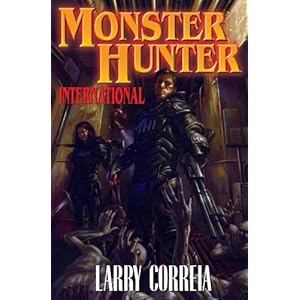
Owen Zastava Pitt is an accountant. Not the typical profession one would normally associate with the protagonist in a book with "hunter" in the title, let alone the word "monster". But when Pitt's boss at his accounting firm turns out to be a werewolf, our protagonist produces a concealed firearm and takes the fight to his insufferable boss. When bullets have no effect, he manages to throw the beast out a window killing it in the multiple story drop. Due to his injuries Owen wakes up in the hospital. he finds out that monsters are real and the government is taking great pains to keep it covered up. The two men in dark suits that come to visit Owen make it absolutely clear that pain is the operative word. But another visit has something else in mind for Owen. His survival against all odds has brought him to the attention of Monster Hunter International, and they have a job for him.
Sounds just like a B-movie, doesn't it? Correia, wisely doesn't try to make the story something that it's not. The cliches are out on proud display. The monsters are for the most part just what you'd expect, there is a prophesy, some dream-walking, and psuedopod who is the really big bad. Corriea doesn't take himself too seriously and it shows. This is a book about killing werewolves and vampires with lots of guns and explosives. It's the side order of cheese that makes it, and Corriea milks it without ever evolving into unintentional satire. Some elitist readers might complain, but I doubt even that. In my experience there aren't many people that don't deep down really love cheese.
In spite of that, Correia manages to elevate his story above its B-movie roots. The characters are surprisingly well drawn. Our narrator, Pitt is a likeable and quirky narrator. While his capabilities are a bit over the top, Correia manages to tie that fact to his back story in a way that in spite of being a little forced doesn't make you groan. The Monster Hunters, who remind me a little of what would happen if Blackwater was staffed by the A-Team, are full of black humor and gung-ho bravado. Many of them seem fairly one note at first, but as their back stories are fleshed out it is easy for readers to find someone to relate to. There are burgeoning friendships, camaraderie, jealousy and grudges aplenty. There is even a significant romantic plot thread that is handled well, even if the object of Owen's desire is something of a go to fantasy for almost every geek out there.
The antagonists while largely straight out of central casting, are more than mustache twirling villains largely due to Corriea's wise use of Pitt's ghost fueled dreams. The monsters are far less interesting than the members of the government's monster control task force charged with policing the hunters and keeping all knowledge of the supernatural from the general populace. The contrasts between the "true believers" in government service and the professional hunters who make scandalous amounts of cash for bringing down monsters of all kinds make for an interesting dichotomy.
The violence is plentiful as are guns of all shapes and sizes. Corriea's knowledge of the subject take center stage here, but he manages to do so without bogging those readers who have little to no knowledge of firearms in the an excess of minutia. Choosing to tell the story from Pitt's viewpoint makes it feel fairly seamless, because the his knowledge mirrors the author's so closely. Action sequences are in your face, loud and flashy, with spent shell casings and explosions in abundance. Many of these sequences would translate well to a summer block buster, and I for one think this story is begging for a translation to a visual media. Readers of the series can feel free to e-mail me to discuss dream casting.
Monster Hunter International excels in all the areas it should, and never makes the mistake for trying to apologize for it. Corriea more than delivers the goods on action, likable characters, and humor while still adding more depth than a reader would have any right to expect given the roots of it's premise. I'll be looking forward to reading more adventures from Pitt and the rest of Monster Hunter International's wild bunch. For now I'm going to whistle the A-Team's theme song and start thinking about my dream movie cast.
Subscribe to:
Posts (Atom)