Showing posts with label You Should Be Reading. Show all posts

Friday, September 28, 2012

You Should Be Reading: Michael J. Sullivan

Thomas Wolfe once famously wrote 'you can never go home again', and as readers that often holds far too true. Going back to the televisions shows and books of our childhood can be a painful experience, as our world view and standards of quality have grown over time. I know from re-watching TV shows like Voltron and The A-Team that nostalgia is best left as wistful remembrances, so you never have to hear "Daddy, this show sucks" from your nine year old only to discover you agree with him.

Books don't suffer as badly, at least in my experience. But they do suffer, especially now that fantasy and science fiction are big business that are targeted, not at children, but adults. Seventeen on the top grossing films of all time are directly tied to science fiction and fantasy in some fashion. (Eighteen, if you count The Passion of the Christ, but I'm not opening that can of worms.) It stands to reason, with that much money to be made, both the writers and readers of fantasy and science fiction have grown more sophisticated, making reading some of the earlier mainstays in the genre seem even more dated and passe on a second viewing. Readers of Weiss and Hickman's Dragonlance novels and David Edding's Belgariad and Mallorean series, would likely agree that while these series remain some of the most formative of our early years as fantasy readers, they are definitely not books we would rush to read again or recommend highly when authors like Rothfuss, Martin, and Abercrombie are dominating the charts.

So what does this all have to do with Michael J. Sullivan, author of the self-published and later commercially successful Riyria Revelation series?  Sullivan's return to the adventure rich, hopeful, and rollicking themes of those older novels, proves while you may not be able to go "home" again, nostalgia can be used to tell powerful and rewarding stories that don't necessarily fit into the more gritty and adult themed stories that make up the bulk of popular fantasy reading today.


The Riyria Revelation follows the adventures of the unlikely partnership of Hadrian Blackwater and Royce  Melbourne. Hadrian is an idealistic swordsman of uncommon skill, possessing the secrets of a legendary warrior caste, while Royce is a cynical thief whose demeanor is as dark as his occupation. If this sounds like a riff on Fafhrd and the Grey Mouser, it's because it is. Sullivan doesn't bother to obscure his use of tropes at all. His thinking seems to be that these archetypes are popular for a reason, and his use of elements familiar to long time fantasy readers doesn't stop with his choice of protagonists. We have elves and dwarves, that are exactly what we expect them to be, an all powerful wizard, a princess that seems fated to fall for one of our heroes, a hidden heir to the throne and more. What makes Sullivan so successful is that he makes no attempt to hide what he is doing and embraces the universality of these elements with an intent to deliver a fast-paced story with likeable characters and nothing more. Focusing on the strength of the characters and knowing exactly what kind of story he intends to tell, gives Sullivan the ability to eliminate the  reams of exposition and meandering plot common in most door-stopper fantasy. Sullivan sets out to entertain and while his characters and settings may be all to familiar, he accomplishes his mission with a calculated light touch that is more common to episodic television than most of today's genre fantasy.

Some may criticize the limited scope of Hadrian and Royce's personalities, finding their relationship little more than a sword and sorcery riff on buddy-cop movies like the Lethal Weapon series. And they wouldn't be wrong, but Sullivan makes it work, allowing the effortless and often comedic nature of the relationship between the two to sell itself. We liked Riggs and Murtaugh, and I think that even the most accomplished and cynical fantasy reader will like Hadrian and Royce as well. They bicker and snipe at each other, but underneath is a grudging respect and love for one another that makes reading their adventures like visiting with old friends. More than anywhere else in the series, this is where Sullivan shines.

This is obviously Hadrian and Royce's story, so secondary characters often seem wooden by comparison. Later volumes allow other characters to step into the limelight, and they fair better then, though they never threaten the star status of either the warrior or the thief. Sullivan handles female characters well, when the spotlight focuses on them. Princess Arista and Thrace are standouts in this regard, though I felt that the end of both of their character arcs was predictable if ultimately satisfying.

The plot of the Riyria Revelations starts off simply. Hadrian and Royce accept a job that seems all too easy, to steal a sword from inside the castle of the king. Predictably, they succeed in acquiring the weapon but are caught red handed before they make their escape. The king has been murdered and our heroes are holding the murder weapon. The duo is placed in the dungeon awaiting trial and certain execution, when they are released by the princess Arista who knows they are innocent and frees them to find the true culprit, the only catch they must take her brother, the heir to the throne, with them. The plot grows in complexity from there, with Sullivan adding layers with each volume in the series, but fans of the labyrinthine plotting of Martin or Weeks will find this series all too simplistic if not predictable. But Sullivan's aim isn't to confound you with reversals, switchbacks and red herrings. He simply wants to tell a rousing tale of heroism and daring, not unlike a very well done campaign of Dungeons and Dragons. And he succeeds, Hadrian and Royce are heroic, almost always likeable, and ultimately successful through either their own considerable skills or sheer dumb luck and coincidence. Things progress quickly as the stakes rise and we see more of the world and the characters that populate it. The stakes rise and predictably so do our characters, leveling up to face the rising threat. But the progression makes sense and is ultimately satisfying as we want Royce and Hadrian to do well. Unlike George R. R. Martin, Sullivan gives readers what they want.

Sullivan's prose is as simple and comfortable as his characters and plot, and The Riyria Revelelations reads more like a episodic television show, than a multi-volume epic fantasy series. Given that Sullivan has stated that he writes with the intention of the writer being as invisible as possible, he should be applauded for never does a overly lengthy description or bit of poetic musing distract the reader from the easy, yet consistent  flow of the tale. This is Royce and Hadrian's tale and Sullivan never tries to make his own. Everything Sullivan does is in service to the story, and if the story is a throw back to simpler days where the heroes were undeniably heroes, the monsters were destined to be slain, and good is destined to triumph over evil, then Sullivan has more than achieved those ends. It may not be a reflection of the complex and often disappointing world we live in, but I would say that we as a people need fairy tales and Sullivan has provided us with one.

Wolfe was right, you never can go home again. But Micheal Sullivan certainly transports readers to a place so reminiscent of the idealistic adventures of our youth that we don't really mind the difference.

Thursday, August 16, 2012

You Should Be Reading: Dan Wells


I don't usually read Young Adult fiction. I occasionally will check out something that has captured some level of zeitgeist. Harry Potter, Katniss Everdeen and  Percy Jackson have a space on my shelves. I hope to  recommend these to my children when they are old enough to start reading these kinds of books. Dan Wells has earned a place on the shelf with Rowling, Collins, and Riordan with his fantastic John Wayne Cleaver novels, though I will probably wait until after Rowling and Riordan are familiar names to my children before I introduce them to young John Cleaver.


John Wayne Cleaver has all of the characteristics of a serial killer, and he knows it. He is an expert on the subject. Even his name seems to condemn him to a predetermined fate. His therapist has diagnosed him as a sociopath, and John now lives by a set of rules designed to keep his darker urges at bay. When a killer begins using his small town as a killing ground, John's macabre fascination and the urge of the hunt send him into conflict with just the kind of monster who John seems destined to become.

If this immediately makes you think of Jeff Lindsay's Dexter series, you aren't alone. But John Cleaver isn't Dexter Morgan any more than Dumbledore is Gandalf. Despite the similarities at the surface of the concept, Wells makes it something all his own with the unique, first person voice of his protagonist. The addition of a twist part way through the book this story steps even farther away from Lindsay's wheelhouse.

The main difference between John Cleaver and Dexter Morgan is that while Dexter is a serial killer, albeit one who only kills the guilty, John is determined not to give into his urges. While those who have read beyond the first novel of Wells' series might call that a gross oversimplification, there more concrete differences. We must also consider the difference between the code of conduct that each character follows. Dexter's rules stem from his desire not to be discovered for the monster that he is. John's rules are designed to prevent him from becoming the monster he fears he will eventually become. Also unlike Dexter, John doesn't always succeed in following his code. Like any teen-aged boy, John has to test his limits and Well's wisely chooses to show the consequences to these lapses in judgement. Whether it is continuing to assist in the family-mortuary business, allowing himself to pursue his crush, or putting himself on a collision course with an actual killer, John's flirtations with his darker impulses always complicate matters for our young protagonist.

Through his attempts to stave off his inner monster, we are introduced to a stable of interesting characters who only serve to highlight the problems John's condition causes. By allowing us to view John's fractured relationship with his mother and sister, his awkward courting of his crush, to his tactical choice of a best friend, Wells manages to create a character that is at the same time alien to readers while keeping a him likable and sympathetic narrator. John's lack of empathy coupled with his awareness that he needs to at least try to hide his lack of feelings from everyone around him, makes the young killer in the making a compelling character that readers want to see succeed.

While initially I Am Not A Serial Killer seem like a crime novel, Well's takes us into genre territory by introducing a twist when the killer's identity is revealed. There is not much exposition about the specifics of the sudden game changing revelation, but I think that serves the story well. Teenage killers in waiting, are probably not prone to playing twenty questions with their prey, and John is no exception. What questions he does have prove hard to answer, and Wells feeds the information to us slowly over the course of the series. It keeps the narration honest even if it may frustrate some readers.

While no slouch in the pacing and plot categories, it's Well's gift for character and the uniqueness of John's narrative voice that propels  I Am Not A Serial Killer and it's sequels into the ranks of books that I think you should be reading, young adult classification or not.


Friday, August 3, 2012

You Should Be Reading: Peter V. Brett

Much like Ken Scholes, I discovered Peter V. Brett's debut novel The Warded Man through the Science Fiction Book Club. To be honest, I almost passed it by because the cover didn't grab me right off. But after a second look I was taken with the synopsis, as it vaguely mirrored an idea I had been playing with for a  roleplaying campaign. Reading the book destroyed the campaign idea, because my ideas paled in comparison to the setting of Brett's engaging novel. By my reckoning, I came out ahead because both The Warded Man and its sequel, The Desert Spear, provided many hours of enjoyment. Throw in the Subterranean Press novels set in the world of the Demon Cycle along with the projected sequels and I have hit something like a book lovers lottery. I decided to only review The Warded Man in detail here, so as not to spoil the other entries in the series. But a review of The Desert Spear and the forthcoming The Daylight War are all but guaranteed.


The world of the Warded Man is a bleak and dangerous place. Through their own arrogance, humanity has fallen from power having lost a war against the demons of the Core, called corelings. The magic that had once allowed them to combat their monstrous enemies has been all but forgotten, save for the defensive wards that protect their homes at night when the corelings rise. Travel is too perilous for all but the bravest of souls. Cities of any size are few and most people live in small isolated communities afraid of the day when a ill-maintained or damaged ward fails, bringing horrible death at the hands of the savage corelings. Fear is a constant weight on the souls of the remnants of a once thriving civilization.

Brett has said in interviews that the effects of and reactions to fear was his intended theme for the book, and it is firmly entrenched in the setting. Travel, limited by the need to be beneath the protection of magic by dusk is perilous, generating the need for the Messengers. These men who live nomadic lives as they take the risks necessary to keep both commerce and trade alive, figure prominently in the story arc of one of our heroes.

Brett's trio of POV characters are young when we are introduced to them, placing The Warded Man in the coming of age category familiar to long time genre readers. Each of these characters is shaped by their choices when faced with things that frighten them and challenge their expectations for their lives. The first is Arlen Bales who is living the simple life of a farm boy in the small village of Tibbet's Brook. While he excels in painting the wards that protect against the corelings he is a prisoner to them.  Even as a youth Arlen yearns for the freedom to travel far from the familiar confines of his isolated home than the nightly coreling attacks will allow. After a coreling attack leaves his mother at death's door while his father watches in terror from behind the protecting curtain of their wards, Arlen has a mission. He will not be a coward, he will learn how to bring the fight to the corelings even if it means leaving his old life behind.

We meet thirteen year old Leesha next. Her home life is bleak, with a verbally abusive mother and hen pecked father whom she loves dearly. Leesha expects her life will turn out like any other young woman who has come before her. She will marry and raise a family, helping to grow the struggling seed of humanity. But those plans are swiftly ended when her fiance starts a rumor that leaves her ridiculed and ostracized by her neighbors. Leesha finds a new path as an apprentice to the crusty village Herb Gatherer, Bruna, whose knowledge of nature gives her the ability to heal and to harm.

Rounding out the trio is Rojer. His story begins with his narrow escape from a coreling attack that leaves him an orphan at the tender age of three. He is rescued and raised as an apprentice by a jongleur, a travelling jester. Disfigured by the corelings, he lacks the dexterity for many of his master's tricks but shows remarkable talent with music, especially with the fiddle.

Brett makes use of a non-linear narrative, jumping not only from character to character but often skipping large chunks of time between each visit with our heroes. It was jarring at first, but most readers should adjust fairly quickly. This technique serves Brett well, allowing him to have his heroes connect at the end of the novel, without needing 1500 pages to get there.

On the way, we get the opportunity to witness the moments that prepare and propel each character into the sometimes reluctant heroes they seem destined to be. We follow Arlen from frightened yet determined boy to the titular warrior who finds a means to fight against the creatures who destroyed his family. Leesha faces the trials and victories of independance, as her spunk and intelligence help her find a place in the community that once spurned her. Rojer's journey is the most drastic, largely because of the amount of time covered. The young jongleur's apprentice discovers not only a magic all his own, but a secret that changes the trajectory of his life.

The pacing is steady, never running down the rabbit holes that seems to plague many epic fantasy novels. All of the events depicted seem to move the characters forward to the expected goal. The magic system fits nicely against the setting connecting in a way that makes perfect sense. The corelings are surprisingly varied in both their temperament and capabilities and Brett wisely leaves himself plenty of freedom to bring fresh ideas to the concept as the series continues.The corelings even manage to show some personality beyond the sterotypical predatory insinct especially in the cycle's subsequent volumes. Combat sequences are fluid, written in a way that hints at some first hand knowledge of the subject. Surprisingly there is not a sword fight in sight, and more martial arts sequences than most genre novels. The thing that struck me most about Brett's writing is that he had a fairly light touch especially considering The Warded Man is his first novel. I found myself too engrossed to bother with the critiquing that often happens when I read a fledgling author.

Making this accomplishment all the more impressive is the fact that much of Brett's novel seems like familiar territory. I have seen some critics who are put off by the numerous tropes that appear in the novel. But Brett uses the familiar to great effect, changing the flavors of your comfort food to a pleasingly different, but never jarring taste that will definitely leave most readers asking for seconds.

There have been many comparisons between Batman's origin and Arlen's story and and I find them pretty apt. In a sense, the Warded Man is meant to be a superhero, battling demons that have reduced humanity to a cowering shadow of their former glory. Brett goes for depth here, showing the sacrifices Arlen must make, and the heavy costs of his quest for the power and skill to reach his goals. Arlen's knowledge of those costs and the refreshing lack of stoicism in the face of his choices gives him a depth beyond the four-color variety.

There is the ever-present prophesy as well. The Deliverer will come and lead humanity against the Corelings.    This prophesy is well handled and doesn't seem to come complete with plot armor. It is my opinion that this prophesy is born from a populace desperate for hope, rather than a magical destiny that happens to belong to our hero. Brett further subverts this trope in The Desert Spear, by placing this mantle on a unlikely character, adding a fresh twist on this common theme.

Brett introduces a nation of spear-wielding desert dwellers in the last third of the book that may look familiar to fans of the late Robert Jordan, but their culture, while familiar, is intrinsically linked to Brett's themes on fear and our reactions to it, viewing it from a cultural rather than a personal level. This also seems to be informed by Brett's personal reactions to September 11th tragedy. This theme is also subverted nicely later.

Brett's later entries into the series only continue to showcase his growing talent. What at first may have seemed like merely one man's take on what has come before is quickly growing into a tale which stands on those worthy stories' shoulders to shout a tale all its own. Speculation that Brett's greater story is posed to be the successor to epic fantasy greats like Jordan and Martin are not unfounded.


Tuesday, July 31, 2012

You Should Be Reading: Ken Scholes

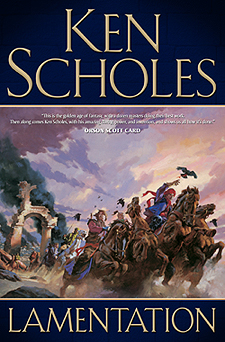
Let's get this right out in the open, I think Ken Scholes is an awesome human being. With that said, I read Ken's first novel, Lamentation before I made this discovery. I stumbled upon Ken's series, The Psalms of Isaak though the Science Fiction Book Club. I was so impressed with the novel that I looked the author up, found his blog and wrote a short note congratulating him on the novel and letting him know how much I had enjoyed it. Much to my surprise we exchanged an email or two. He shared writing tips and other pleasantries and seemed a humble and friendly fellow. I felt lucky to have shared a bit of correspondence with an up and coming author who's work I had particularly enjoyed. Fast forward a bit, and I friended him on Facebook not expecting anything more than updates on his writing and other such things. But on a whim, I messaged him when I saw him online, and he took the time to chat with me briefly and encourage me in my own writing. We've corresponded a bit more since then and I always walk away from the keyboard feeling uplifted and encouraged. He's even commented on a few of my status updates regarding my work in progress.

Since then I've read the next two novels in his series, Canticle and Antiphon and my enjoyment in the world, characters, and story he's created has only increased. I recommend them frequently, always with the addendum that Ken is a awesome guy on top of being an incredibly talented writer. I've been disappointed that it seems that Ken doesn't get the recognition of some of the other authors I enjoy that are up and comers. I know that Ken still has a day-job, and twin girls to raise, and I would love to see him gain enough popularity to be able to write full time. I'm being selfish, it means more books for me. So here I am plugging the series. Take a gander at my thoughts on the books and then if you like what you see, pick up Lamentation and join the tribe.


The Psalms of Isaak starts off with the destruction of Windwir, home to the great library of the Androfrancine Order who protects the world from the knowledge that predates the last great apocalypse that nearly destroyed civilization. The population of Windwir is wiped off the map by an act of terrorism that is perpetrated by a mechano-servitor named Isaak who has a secret all his own.

Scholes' cast of characters is sizable and their reactions to the destruction of their worlds greatest city are varied and reflect their places in the world. I found something to relate to with every point of view character and was surprised to find myself identifying with characters I have absolutely no common ground with. Petronus, an aging former Head of the Androfrancines is a definite stand out as are Jin Li Tam and the titular Isaak. Scholes has the ability to write a wide variety of characters with an even handed skill that reminds me of no other author so much as George R. R. Martin.

The political fallout and machinations of the various factions seeking answers and retribution for the destruction of Windwir, while not as labyrinthine as those in A Song of Ice and Fire are complex enough that you'll be kept guessing and fans of that wildly popular series will not be disappointed.

Another stand out feature of Scholes' world is the fact that he blends traditional sword and sorcery with science fiction and some elements of steam punk so well. The result is a world unlike any other I have encountered in the hundreds of other world fantasy novels I've read. The elements of science fiction are gradually introduced over the course of the published books and I was quite surprised with the direction the series seems to be headed in. Much like Lamentation the series as a whole promises to take readers to places and directions they'd not expected.

I won't risk any more spoilers, by reviewing the other two books in the proposed five book cycle, but hopefully this will whet your appetite enough that you'll give Lamentation a try. I guarantee you won't be disappointed, and like I said in the beginning Ken Scholes is an awesome guy and in a perfect world that should mean something.

See he even looks like a nice guy!